
Private Label Food Brand: How to Win Shelves | Harvestia
Private label food has shed its bargain-bin reputation. What used to be the supermarket's 'cheaper alternative' has become one of the most strategic plays in modern retail — a space where margins, brand loyalty and product innovation now meet. From premium spice ranges and artisanal pulses to organic flours, single-origin oils and gourmet ready-to-cook kits, private label is where some of the most exciting consumer brands of the decade are being built.
For entrepreneurs, retailers and FMCG operators entering or scaling this space, the playbook has changed. Winning a shelf is not about being the cheapest option on the aisle. It is about packaging that tells a story before a customer even reads it, quality control that holds up under retail buyer scrutiny, and a positioning strategy that earns repeat purchase, not just a curious first try.
This guide breaks down how to build a private label food brand that actually wins shelves, retains customers and protects margins — covering packaging design, manufacturer selection, compliance, quality control and brand positioning. Whether you are launching your first SKU or scaling a portfolio of 50, the principles below will help you separate signal from noise.
How to Build a Private Label Food Brand That Wins Shelves
Private label is no longer a defensive category for retailers; it is an offensive category for ambitious food brands. Global research from major retail consultancies estimates that private label is growing 1.6x faster than national brands across most developed grocery markets, and even faster in emerging markets where consumer trust in retailer-curated products is rising sharply. Categories like spices, condiments, healthy snacks, breakfast cereals, plant-based foods and premium pantry staples are leading this surge.
The opportunity is layered. Retailers want private label SKUs because they protect margins and differentiate their store experience. Consumers want them because they perceive (often correctly) better value, more curation and increasingly comparable or superior quality. Manufacturers want them because they unlock predictable volume and reduce dependency on a small set of branded customers. The middle player who can bridge these three — and design a brand worth choosing — captures disproportionate value.
The Three Pillars of a Winning Private Label Strategy
Strip away the noise and every successful private label food brand stands on three pillars. Get all three right and the shelf works for you; get any one wrong and the product struggles, no matter how good the formulation is.

Packaging That Sells Itself on a Crowded Shelf
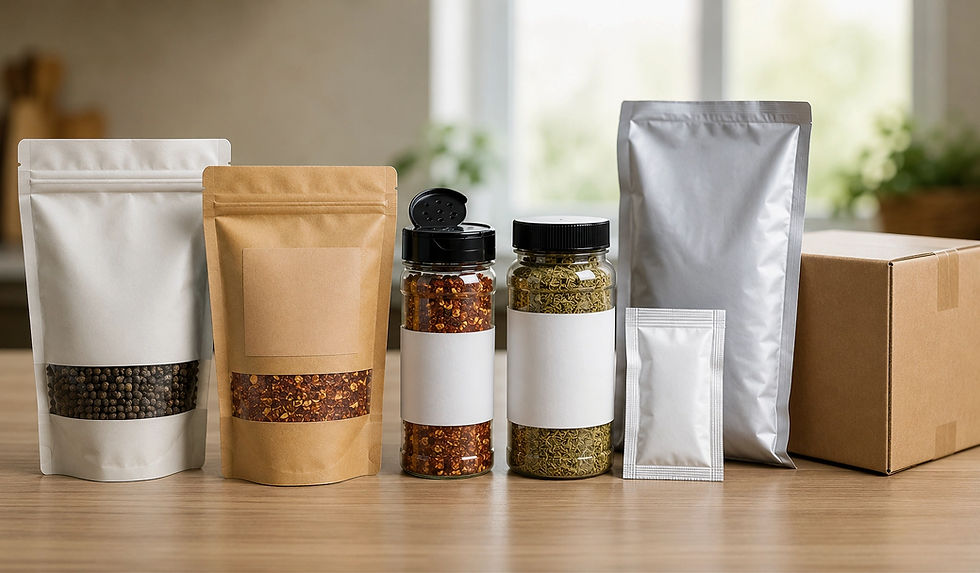
Shoppers spend an average of 3 to 7 seconds scanning a shelf before making a decision. In that window, packaging is the only sales pitch you have. Winning private label packaging combines a clear category cue (so the shopper instantly knows what the product is), a strong brand cue (so it stands apart from competitors) and a credibility cue (so the shopper trusts the quality at a glance). The most defensible packaging strategies invest in distinctive colour systems, premium materials like kraft paper or matte finishes, intentional typography hierarchies and storytelling elements like origin badges and farmer photos.
Quality Control That Earns Repeat Orders
Packaging gets the first purchase; quality control earns the second, third and tenth. A private label brand with inconsistent batches will burn through trust and shelf placement faster than it can refresh artwork. Every winning private label operation invests in incoming raw material checks, in-process production controls, finished-good lab testing, batch-level traceability and clearly defined acceptance/rejection criteria. The discipline is not glamorous but it is the single biggest determinant of long-term shelf survival.
Market Positioning That Defends Margins
Private label brands that compete only on price get trapped in a race to the bottom. Brands that position themselves on a clear value pillar — premium origin, clean label, dietary specialisation (gluten-free, vegan, keto), regional authenticity or convenience — earn the right to charge more and protect margins. The best private label founders ask themselves a simple question: 'Why would a consumer pick this over the leading national brand and over the store brand?' If the answer is fuzzy, the positioning is not yet finished.
Designing Packaging That Drives Shelf Conversions
Beautiful packaging that doesn't sell is a vanity project. Functional packaging that doesn't move shoppers emotionally is a missed opportunity. The best private label food packaging gets both right by following a disciplined design framework:
Define the shopper mission: What problem is the consumer solving when they pick up this SKU — speed, indulgence, health, authenticity? Anchor every visual decision in that mission.
Lock the category code: Use colour, imagery and shape to instantly signal the category. Fighting category norms confuses shoppers and slows conversion.
Build a distinctive brand block: Identify two or three brand assets — a colour, a frame, a wordmark — that remain consistent across every SKU.
Add proof at a glance: Origin badges, certifications, percentage callouts and short trust phrases convert scepticism into confidence.
Design for the shelf, not the screen: Test packaging mockups at actual shelf height, with competing brands beside them — not just in a clean Behance render.
Build a system, not a single SKU: Plan how new variants and line extensions will fit visually before launching SKU number one.

Choosing the Right Private Label Manufacturing Partner
Your manufacturing partner is your brand's silent co-founder. They influence quality, lead times, costs, compliance, scalability and even innovation speed. The wrong partner will choke a great brand; the right one will accelerate it. When evaluating a private label manufacturer, the best founders go beyond pricing sheets and dig into the operational reality:
Certifications and audits: FSSC 22000, BRC, HACCP, organic certifications and country-specific food safety standards relevant to your target markets.
Capability fit: Can they handle your specific format — grinding, blending, roasting, freeze-drying, ready-to-cook, ambient or chilled — at the volume you need this year and next?
Minimum order quantities (MOQs): Do their MOQs match your launch budget, and do they offer a clear path to scale without renegotiating from scratch?
Quality control infrastructure: In-house labs, calibrated equipment, documented SOPs and traceable batch records — not just verbal assurances.
Transparency and communication: Do they share production schedules, raw material origins and QC reports willingly, or does information feel guarded?
Innovation appetite: Are they willing to co-develop new SKUs, support clean-label reformulations and trial new packaging formats?
Building Trust Through Compliance and Transparency
Compliance used to be the legal team's problem. In modern private label, it is a brand asset. Strong compliance — accurate labels, validated nutrition data, allergen declarations, country-of-origin disclosures, sustainability claims that can be defended — protects a brand from regulator headaches and consumer scepticism. It also unlocks premium retail placements that low-compliance competitors cannot access.
Forward-looking private label brands publish their commitments openly: clean-label promises, sourcing principles, packaging recyclability goals and quality control standards. They build a 'quality charter' page on their website that customers can read, share and reference. They treat third-party certifications as proof points, not trophies. When trust is the new currency on the shelf, transparency is the cheapest way to earn it.
Scaling Your Private Label Brand Without Losing Its Soul
The most common founder mistake at the scaling stage is dilution — adding too many SKUs too quickly, chasing every trending category, or accepting any retail listing that comes along. Scaling a private label brand sustainably means staying disciplined about category focus, listing quality and operational readiness. A few principles that successful operators share:
Great private label brands are not built by saying yes to every opportunity. They are built by saying no to the wrong ones — every single quarter.
Stay anchored to your value pillar: Every new SKU should reinforce the brand's core promise, not contradict it.
Earn the right to expand: Prove the model with a tight 5–8 SKU range before extending into adjacent categories.
Invest in supply chain depth: Backup suppliers, multi-source raw materials and buffer inventory protect availability as you grow.
Treat data as a feedback loop: Velocity per store, repeat rates and basket co-purchase data should shape every new launch and listing decision.
Protect the brand experience: Out-of-stocks, inconsistent quality and packaging errors cost more than slow growth ever will.
Common Pitfalls That Sink Private Label Food Brands
For every successful private label brand on the shelf, several others quietly disappear within 12 to 18 months. The most common reasons are surprisingly avoidable:
Over-relying on one retail customer: Concentration risk can destroy a brand overnight if the listing is dropped or terms change.
Skipping consumer research: Founders who fall in love with a recipe before validating demand often build the wrong product beautifully.
Under-investing in packaging: Cheap-looking packaging telegraphs cheap quality, even when the product inside is excellent.
Ignoring shelf life and logistics: A premium product that bloats freight costs or struggles with shelf life loses listings fast.
Treating private label as 'easy mode': Private label is operationally complex — pretending otherwise is the fastest path to a stalled brand.
The Final Word on Private Label Food Branding
Private label food is one of the most exciting consumer categories of the decade — but it rewards discipline over hustle, systems over slogans and quality over quantity. Brands that combine genuinely thoughtful packaging, rigorous quality control, defensible positioning and a trustworthy manufacturing partnership are the ones that win shelves, hold them and turn them into long-term consumer loyalty.
Harvestia partners with founders, retailers and FMCG teams to build private label food brands from concept to shelf — handling sourcing, formulation, compliance, packaging and supply chain. If you are planning a new private label range or scaling an existing one, talk to our team to see how a structured partnership can shorten your time to shelf without compromising the brand you are trying to build.
Pricing Your Private Label Food Product the Right Way
Pricing is where private label food brands either build a profitable, defensible business or accidentally trap themselves in unsustainable margins. The smartest founders combine cost-based discipline with value-based ambition, never relying on either alone. A clear pricing framework usually involves four moves:
Calculate fully loaded cost per unit: Raw material, packaging, manufacturing, logistics, listing fees, returns reserve, marketing reserve and overhead allocation — leave nothing out.
Set a target retail margin: Premium private label categories typically aim for 40–60% retail margin; leaner volume plays may settle for 25–35%.
Benchmark against shelf competitors: Map every comparable SKU on the shelf by price-per-100g, by certifications and by perceived premium-ness; position deliberately.
Stress-test with promotion math: Plan promotions before launch — discounted price, frequency and duration — and confirm the margin still holds.
Frequently Asked Questions From Private Label Food Founders
How long does a typical private label food launch take from concept to shelf?
A focused launch can move from brief to shelf in 12 to 20 weeks when packaging, formulation and supply chain decisions run in parallel. More complex categories — chilled, frozen, fortified or claim-heavy SKUs — typically need 24 to 36 weeks for compliance, stability testing and label validation.
What is the minimum budget to launch a serious private label food brand?
While it varies by category, a credible launch covering brand identity, packaging design, manufacturing setup, first inventory run, compliance, photography and basic marketing usually requires a working capital pool that supports six to twelve months of operations without revenue cushion. Underfunded launches are the single biggest reason promising brands die early.
How important are certifications for a private label food brand?
Critical for premium positioning, organic claims, allergen claims and export ambitions; useful but not always essential for mass-market plays. Choose certifications that match the consumer promise, not the founder's preference. Over-certifying eats into margin without unlocking proportional sales.
Should I build a single brand or a multi-brand house?
Most successful operators start with a single, sharply defined brand and only build a second brand when the first is established, profitable and operationally settled. Multi-brand portfolios divide attention and dilute supply chain leverage if launched too early.
The Operational Foundations Behind Every Successful Launch
Behind every confident-looking private label food brand sits a quiet, disciplined operating system. Inventory forecasts that update weekly. A documented quality control playbook. A list of approved suppliers with backup contingencies. A pricing model that recalculates with every commodity shift. A marketing calendar that lines up with retail planograms. A clear escalation tree when something goes wrong. The brands that survive their second and third year invest in this operating infrastructure as early as they invest in their packaging.


Comments