
Private Label Food Manufacturing: The Complete Guide to Building a Profitable Food Brand Without Owning a Factory
Published by Harvestia Group | Updated March 2026
"Private label food manufacturing is no longer the discount aisle secret — it's the $277 billion engine powering the world's fastest-growing food brands."
Table of Contents
What Is Private Label Food Manufacturing?
Why Private Label Food Is Booming Right Now
How Private Label Food Manufacturing Actually Works
Types of Private Label Food Manufacturing
Key Product Categories in Private Label Food
How to Find the Right Private Label Food Manufacturer
Private Label Food Compliance, Certifications & Regulations
Packaging for Private Label Food Products
Pricing Strategy for Private Label Food Brands
Private Label Food Manufacturing in India
Building Your Private Label Food Brand
Common Mistakes to Avoid
Frequently Asked Questions
What Is Private Label Food Manufacturing?
Private label food manufacturing is the process by which a third-party manufacturer produces food products to your specifications, and you sell those products under your own brand name. You own the brand. The manufacturer stays invisible.
This model is used by everyone from global retailers like Walmart, Tesco, and Aldi to ambitious indie food entrepreneurs launching premium spice blends, health supplements, sauces, or functional beverages — without ever investing in production equipment.
In simple terms: you design the product, control the brand, and own the customer relationship. The manufacturer handles the cooking, blending, filling, and sealing.
Private label food is different from:
White label food — where you simply rebrand a standardised, off-the-shelf product with zero customisation
Contract manufacturing — which is a broader term often used interchangeably, but technically focuses on manufacturing-to-spec rather than brand-building
Co-manufacturing — where a brand and manufacturer jointly produce and often share intellectual property
In the most powerful form of private label food manufacturing, you bring a recipe, formula, or product brief. The manufacturer sources raw materials, produces the food to your specs, passes it through quality control, and packages it under your label — ready to ship to your retailer, distributor, or e-commerce customer.
Why Private Label Food Is Booming Right Now
The numbers are striking and impossible to ignore.
According to the Private Label Manufacturers Association (PLMA), private label dollar sales in the United States rose 4.4% in the first half of 2025 versus the same period the prior year — growing at nearly four times the rate of national brands, which only managed 1.1% growth.
Total US private label food and grocery sales are projected to approach $277 billion in 2025, surpassing the 2024 record of $271 billion. In just four years (2021–2024), private label sales surged by over $51 billion — a 23.6% gain.
Globally, the private label packaged food market was valued at $415.53 billion in 2024 and is projected to reach $581.97 billion by 2030, growing at a CAGR of 5.8%.
Why is private label food growing so fast? Here are the five real drivers:
1. Quality Has Caught Up to National Brands
For decades, private label food was the "cheap option." That era is over. Today's contract manufacturers use the same ingredients, the same technology, and often the same facilities as national brand manufacturers. Consumers have noticed.
2. Inflation Has Shifted Consumer Behaviour Permanently
With grocery prices up roughly 25% over the past five years, shoppers have retrained themselves. They started buying private label out of necessity — and stayed because the quality surprised them.
3. Retailers Are Investing Heavily in Their Own Brands
Walmart launched Bettergoods in 2024. Kroger continues to expand Simple Truth. Aldi and Lidl have built entire business models around private label. Retailers now view own-brand as a margin driver, a differentiation tool, and a loyalty mechanism — not just a budget filler.
4. Premium Private Label Is the Fastest-Growing Tier
This is the most exciting data point for entrepreneurs. The premium private label tier grew 76% between 2021 and 2025, far outpacing the mid-market (65%) and value tiers (35%). Shoppers aren't just buying private label to save money — they're buying it because it's genuinely good.
5. Asia Pacific Is the New Frontier
The Asia Pacific private label food market is expected to contribute 24.5% of global market share in 2025, fuelled by a growing middle class, expanding modern retail, and rising consumer sophistication in markets like India, China, and Southeast Asia.

How Private Label Food Manufacturing Actually Works
Understanding the private label food manufacturing process end-to-end is essential before you invest a single rupee, pound, or dollar. Here is the complete lifecycle:
Step 1: Product Concept & Brief
Everything starts with your product brief. This document defines:
The product category (spice blend, ready-to-eat meal, health supplement, beverage mix, etc.)
Target consumer and positioning (mass market, premium, functional, organic)
Desired ingredients, flavour profile, and texture
Certifications required (organic, halal, kosher, vegan, gluten-free)
Target shelf life
Packaging format (pouch, tin, glass jar, bottle, retort pouch)
Minimum order quantity (MOQ) expectation
Target factory-gate price
Step 2: Manufacturer Selection
Finding the right private label food manufacturer is the most consequential decision in this entire process. You need a manufacturer who:
Has experience in your specific product category
Holds the relevant food safety certifications (FSSAI, BRC, SQF, HACCP, ISO 22000, FSSC 22000)
Can work within your MOQ and budget
Has demonstrable quality control processes
Will sign a non-disclosure agreement (NDA) and brand exclusivity clause
Has export capability if you're selling internationally
Step 3: Formulation & R&D
For custom formulations (as opposed to white label stock products), the manufacturer's R&D team will develop a recipe to your brief. This stage involves:
Prototype development (typically 2–5 rounds)
Sensory evaluation and consumer testing
Shelf life testing and stability studies
Nutritional analysis for label compliance
Step 4: Regulatory Compliance & Label Design
Before production begins, your product must be fully compliant with the regulations of your target market. In India, this means FSSAI licensing and compliant labelling. For UK exports, you need to meet UK Food Standards Agency requirements. For the US, FDA labelling rules apply.
Your packaging label must include:
Product name and description
Ingredient list (in descending order of weight)
Nutritional information panel
Allergen declarations
Country of origin
Manufacturer's address (or brand owner's address)
Net weight / volume
Best before / expiry date
Batch code and traceability information
Any relevant certifications and logos
Step 5: Production Run
Once prototypes are approved and compliance is confirmed, the manufacturer schedules your production run. You'll typically provide a purchase order (PO), and the manufacturer will:
Source raw materials
Schedule production
Conduct in-process quality checks
Fill and seal packaging
Apply labels
Conduct finished goods testing (microbiology, chemical, physical)
Package into outer cartons for dispatch
Step 6: Quality Assurance & Testing
Before goods leave the factory, a responsible private label food manufacturer will conduct:
Microbiological testing — Total plate count, yeast & mould, coliforms, Salmonella, E. coli
Chemical testing — Moisture content, pesticide residues, heavy metals, mycotoxin levels
Physical testing — Foreign matter inspection, weight checks, seal integrity
Organoleptic assessment — Colour, aroma, flavour, texture against approved standard
Step 7: Logistics & Fulfilment
For domestic orders, the manufacturer dispatches to your warehouse or directly to your retailer/distributor. For export, you'll need to manage:
Export documentation (Commercial Invoice, Packing List, Certificate of Origin, Health Certificate, Phytosanitary Certificate if applicable)
Customs clearance in the destination country
Import duties and tariffs
Insurance

Types of Private Label Food Manufacturing
Not all private label food manufacturing arrangements are the same. Here are the main structures you need to understand:
1. White Label Manufacturing
The simplest form. The manufacturer already produces a standardised product — say, a turmeric latte mix or a blended chilli powder. You purchase it in bulk, apply your brand label, and sell it. There is no formulation work, minimal MOQ, and fast turnaround. Margins are lower because any competitor can source the same product from the same manufacturer.
Best for: Brands testing a new category quickly with low upfront investment.
2. Custom Formula Private Label
You bring a proprietary recipe or work with the manufacturer's R&D team to develop a unique formulation. The formula is owned by you (protected by NDA) and cannot be produced for other brands. This creates genuine product differentiation and defensibility.
Best for: Serious food brands building long-term competitive advantage.
3. Contract Manufacturing
You supply the formula, and the manufacturer produces entirely to your specifications — sometimes you even supply specific raw material sources. This is common in premium and functional food segments where ingredient provenance matters.
Best for: Established brands with proven formulas scaling into larger manufacturing capacity.
4. Tolling / Processing
You supply the raw materials; the manufacturer provides processing, blending, filling, or packaging services only. You pay a "toll" for the processing. Common in the spice industry — e.g., you source raw cumin, the manufacturer cleans, grinds, and packs it.
Best for: Brands with strong raw material sourcing capabilities who want to control ingredient quality absolutely.
5. Co-Packing
The manufacturer packages your pre-made or pre-mixed product. You handle the blending or cooking elsewhere; they handle the fill-and-seal, labelling, and palletising.
Best for: Artisan brands scaling beyond in-house production.

Key Product Categories in Private Label Food
Private label food manufacturing is not limited to any single category. Here are the highest-growth and most accessible product categories:
Spices, Masalas & Seasonings
One of the most mature and accessible private label food categories globally. India produces 75% of the world's spices, making Indian private label spice manufacturing particularly attractive for international buyers. Key products include:
Single-origin spices (turmeric, cumin, coriander, chilli, black pepper, cardamom)
Proprietary spice blends and masalas
Seasoning rubs and marinades
Functional spice mixes (golden milk blends, anti-inflammatory blends, adaptogen spice mixes)
MOQ: Typically 50–200 kg for spices; 100–500 kg for blends Lead time: 3–6 weeks
Health & Functional Foods
The fastest-growing segment in private label food manufacturing globally. Includes:
Protein powders and meal replacement blends
Superfood mixes (spirulina, moringa, ashwagandha, turmeric)
Instant healthy beverage mixes (golden latte, matcha, saffron blends)
Nutraceutical food powders
Organic and adaptogen-infused products
MOQ: 100–500 kg depending on format Lead time: 4–8 weeks (longer if custom capsule or tablet form)
Ready-to-Eat (RTE) and Ready-to-Cook (RTC)
Rapidly growing category driven by convenience and urban consumption:
Retort pouch meals (curries, dal, biryani, tikka masala)
Frozen RTE products
Shelf-stable snacks and namkeen
Meal kits and cooking sauces
MOQ: 500–2,000 units depending on product complexity Lead time: 6–12 weeks
Condiments, Sauces & Pastes
Hot sauces and chilli oils
Chutneys and pickles
Cooking pastes (garlic-ginger paste, curry base)
Salad dressings and marinades
Artisan jams and preserves
Bakery Ingredients & Mixes
Cake mixes and bread premixes
Cookie and biscuit dough bases
Gluten-free baking blends
Decorating sugars, icings, and toppings
Beverages & Drink Mixes
Instant coffee blends
Herbal tea and tisane blends
Functional drink powders (energy, immunity, sleep)
Chai mixes and masala tea blends
Cold-pressed juice concentrates
Organic & Plant-Based Foods
Plant-based protein powders
Organic grain and seed blends
Vegan snack foods
Organic baby food and weaning products
How to Find the Right Private Label Food Manufacturer
Finding a reliable private label food manufacturer is the single biggest challenge for new food brands. Here is a structured approach:
Online Directories & Platforms
For India-based manufacturers:
IndiaMART — India's largest B2B marketplace. Search for "private label spice manufacturer," "contract food manufacturer India," "white label masala manufacturer" etc.
TradeIndia — Secondary B2B directory
IndiaBizClub — Niche food manufacturing listings
Spices Board of India — Official directory of registered spice exporters
For global sourcing:
Alibaba — Global B2B platform (China, South Asia, Southeast Asia)
Thomasnet — US and European manufacturers
PLMA (Private Label Manufacturers Association) — Industry body with verified manufacturer listings
Trade Shows
PLMA World of Private Label (Amsterdam & Chicago) — The world's largest private label trade show
Anuga (Cologne, Germany) — Global food and beverage trade fair
SIAL (Paris) — International food innovation exhibition
India Food & Beverage Expo — India-specific event
World Spice Congress (India) — Spice industry focused
Referrals & Networks
The most reliable manufacturers are often found through industry referrals. Join food entrepreneur communities, reach out to other brand owners (non-competing), and ask your packaging supplier who they work with.
Vetting Checklist
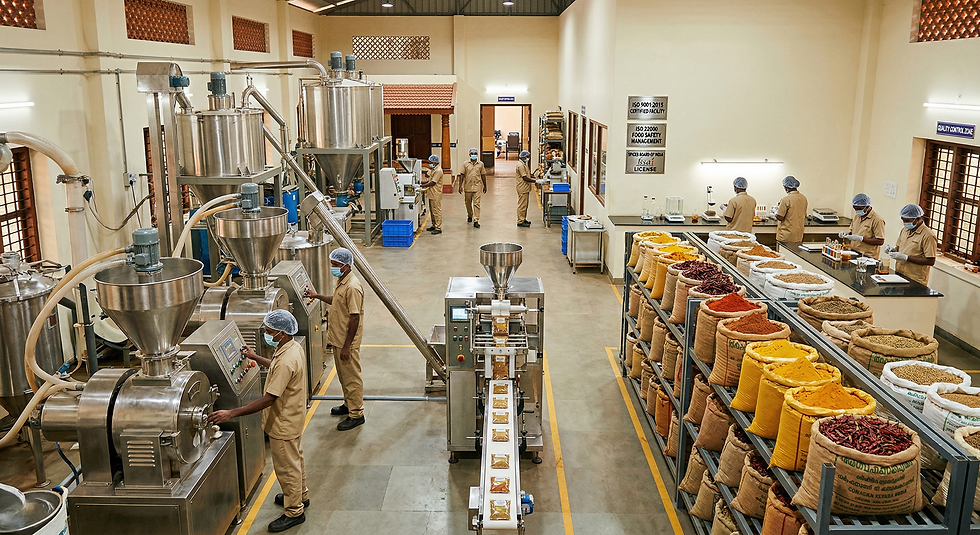
Before committing to any private label food manufacturer, verify:
[ ] Active FSSAI licence (for India) or relevant food safety certification
[ ] BRC, SQF, FSSC 22000, or ISO 22000 certification
[ ] Halal / Kosher certification (if required)
[ ] Organic certification (NPOP for India, NOP for US, EU Organic for Europe)
[ ] Spices Board CRES registration (for Indian spice exporters)
[ ] Factory audit report (third-party preferred)
[ ] References from existing clients
[ ] Sample products for evaluation
[ ] Signed NDA before sharing any proprietary formulas
[ ] Clear terms on IP ownership, exclusivity, and MOQ
Private Label Food Compliance, Certifications & Regulations
Compliance is non-negotiable in private label food manufacturing. Getting it wrong can result in product recalls, import rejections, regulatory fines, and catastrophic brand damage. Here is what you need to know:
India: FSSAI (Food Safety and Standards Authority of India)
FSSAI is the regulatory backbone of India's food industry. Every food manufacturer and food business operator in India must hold a valid FSSAI licence or registration.
Licence types:
Basic Registration — For very small manufacturers/traders (turnover < ₹12 lakh)
State Licence — For medium-scale manufacturers (turnover ₹12 lakh – ₹20 crore)
Central Licence — Required for manufacturers with turnover > ₹20 crore, or any manufacturer exporting food products
For private label food manufacturing at scale, your contract manufacturer must hold a Central FSSAI Licence. Your own brand entity should also hold appropriate FSSAI registration if you're involved in distribution or trading.
Key FSSAI labelling requirements:
Product name, brand name
List of ingredients in descending order
Nutritional information per 100g/100ml and per serving
Allergen declarations (in bold)
Vegetarian/Non-vegetarian symbol (mandatory in India)
FSSAI licence number of manufacturer
Best before / expiry date
Batch/lot number
Net quantity
MRP (for domestic Indian products)
Export Compliance: Spices Board of India
For Indian spice exporters, registration with the Spices Board of India under the Compulsory Registration of Exporters of Spices (CRES) scheme is mandatory. This registration:
Validates your business as a legitimate spice exporter
Enables access to quality certification services
Is a prerequisite for obtaining health and phytosanitary certificates for export
Fee: ₹11,800 for new registration (as of 2025) Where to apply: ESS portal (spicesboard.gov.in)
International Certifications Your Manufacturer Should Hold
Certification | What It Covers | Required For |
HACCP | Hazard analysis and critical control points | Most international buyers |
ISO 22000 | Food safety management systems | European and premium buyers |
BRC Global Standard for Food Safety | Retailer supply chain | UK and EU retail |
SQF (Safe Quality Food) | North American retail supply chains | US and Canadian retail |
FSSC 22000 | Comprehensive food safety | Premium global buyers |
Organic (NPOP/NOP/EU Organic) | Certified organic production | Organic product claims |
Halal | Compliance with Islamic food laws | Middle East, Muslim-majority markets |
Kosher | Compliance with Jewish dietary laws | US, Israel markets |
Non-GMO | No genetically modified organisms | US, EU health-conscious consumers |
UK Market Compliance
For brands selling into the UK post-Brexit, key requirements include:
UK Food Standards Agency (FSA) labelling compliance
UKCA marking where applicable
Pre-notification for certain high-risk food imports (particularly products of animal origin)
Import health certificates for specific categories
UK-specific allergen labelling (14 major allergens in bold in the ingredient list)
Country of origin labelling
US Market Compliance
FDA registration for food facilities
Nutrition Facts Panel in FDA format
FSMA (Food Safety Modernisation Act) compliance
DUNS number and FDA facility registration number on import documentation
Labelling compliance with 21 CFR Part 101

Packaging for Private Label Food Products
Your packaging is the first thing your customer sees. In private label food manufacturing, packaging is your primary brand expression — it's where your brand identity lives, breathes, and sells.
Primary Packaging Formats
Flexible Pouches Stand-up pouches (SUPs), flat pouches, and re-sealable zip pouches are the most popular format for dry food products. They offer excellent shelf presence, print quality, and barrier properties. Available in:
Kraft paper (natural, sustainable aesthetic)
Metalized foil (premium barrier, long shelf life)
Transparent window pouches (product visibility)
Matte laminate (premium feel)
Tins & Canisters Metal tins offer an upmarket, artisanal feel. Particularly popular for spices, coffee, tea, and superfood blends. Options include:
Lithographic printed tins (full-colour design directly on metal)
Plain tins with applied labels
Re-sealable lid designs
Glass Jars & Bottles Used for sauces, condiments, preserves, and premium liquid products. Glass communicates quality and is preferred by health-conscious, premium consumers.
Rigid Plastic Containers Cost-effective for high-volume products. Less premium perception but practical for mainstream retail.
Retort Pouches For shelf-stable ready-to-eat products. High-pressure processing (HPP) retort pouches are revolutionising the RTE food category.
Secondary and Tertiary Packaging
Outer cartons — Corrugated brown cartons for bulk shipping
Master cartons — For retail cases (typically 6, 12, or 24 units)
Display boxes — For in-store shelf units
Pallet configurations — For logistics optimisation
Label Design Essentials
Your product label must achieve three things simultaneously:
Comply with all regulatory requirements
Communicate your brand clearly and memorably
Convert — attract attention on shelf or online and persuade purchase
Key design principles for private label food labels:
Use a distinctive brand colour palette (consistent across all SKUs)
Invest in professional typography — avoid generic fonts
Include clear product photography or illustration
Highlight your key differentiator (organic, single-origin, award-winning, etc.)
Keep the back label clean and easy to read
Use QR codes to link to traceability and brand storytelling

Pricing Strategy for Private Label Food Products
Getting your pricing right is the difference between a profitable food brand and one that bleeds cash. Here's how to think about it:
Understanding the Cost Stack
Every private label food product has a fully-loaded cost that includes:
Cost Component | Typical % of Factory Price |
Raw materials (ingredients) | 40–60% |
Processing / manufacturing labour | 15–25% |
Packaging materials | 10–20% |
Factory overheads | 5–10% |
Quality control & testing | 3–5% |
Regulatory & compliance costs | 2–4% |
Total Factory Gate Price (FOB India) | 100% |
Landed Cost vs Factory Price
Your landed cost — what it actually costs to get the product into your warehouse — is significantly higher than the factory gate price:
Freight (sea/air): +5–20% depending on mode and distance
Import duties & tariffs: +0–30% depending on product and destination country
Customs clearance & handling: +2–5%
Warehousing: +3–8%
Total Landed Cost: typically factory price × 1.3–1.6
Pricing to the Market
A sustainable private label food business typically works with these margins:
Your selling price to distributor/retailer: Landed cost × 2.0–2.5 (50–60% gross margin)
Retailer's selling price to consumer: Your price × 1.5–2.5 (depending on retailer type)
Example — Premium Spice Blend:
Factory gate price (India): ₹180/unit (approx £1.70)
Landed cost UK (freight, duties, handling): £2.80/unit
Your brand's trade price to UK retailer: £5.50/unit
Retailer's consumer price: £9.99–£12.99
MOQ & Economies of Scale
Private label food manufacturing economics improve dramatically at scale. A general guide:
Order Volume | Typical Price Impact |
MOQ (minimum order) | Baseline price |
2× MOQ | 5–10% reduction |
5× MOQ | 15–20% reduction |
10× MOQ | 25–35% reduction |
Always negotiate MOQ down for initial orders (trial batch), and lock in volume-based pricing agreements once you've validated the market.
Private Label Food Manufacturing in India
India has emerged as one of the world's most compelling destinations for private label food manufacturing — and the opportunity is only growing.
Why India?
1. Raw Material Abundance India is the world's largest producer of spices, the second-largest producer of fruits and vegetables, and a major producer of pulses, grains, oilseeds, and dairy. Access to world-class raw materials at source means lower costs and fresher supply chains.
2. Cost Advantage Indian private label food manufacturing costs are typically 30–50% lower than equivalent European or US production, without compromising on quality — particularly for spice-based, vegetarian, and plant-based products.
3. Regulatory Maturity India's FSSAI framework has evolved significantly. World-class manufacturers now hold BRC, ISO 22000, FSSC 22000, HACCP, NPOP Organic, and Spices Board certifications — meeting the most demanding international buyer requirements.
4. Export Infrastructure India's food export infrastructure — logistics, cold chains, air freight capacity, and customs processes — has improved substantially. Major food export clusters exist in Gujarat (Unjha for spices, Rajkot for groundnuts), Maharashtra (Pune and Mumbai), Tamil Nadu, Andhra Pradesh, and Kerala.
5. R&D Capability India is home to world-class food R&D institutions — CFTRI Mysore, AAU Anand, NIFTEM — with deep expertise in spice processing, functional foods, traditional formulations (Ayurveda, Siddha), and food technology.
Key Private Label Food Manufacturing Hubs in India
Region | Specialisation |
Unjha, Gujarat | Spices (cumin, fenugreek, fennel, spice blends) |
Kochi, Kerala | Pepper, cardamom, spice oleoresins |
Guntur, Andhra Pradesh | Chillies and chilli-based products |
Mysore, Karnataka | Processed spices, CFTRI proximity |
Pune, Maharashtra | Processed foods, RTE products |
Ludhiana, Punjab | Grain-based products, flour, snacks |
Chennai, Tamil Nadu | Condiments, pickles, sauces |
Working with Indian Manufacturers from Abroad
If you are based in the UK, US, Middle East, or elsewhere and sourcing from India, here are the key success factors:
Appoint a local representative or sourcing agent in India who can conduct factory visits and manage day-to-day supplier relationships
Get samples before committing — always evaluate at least two rounds of samples against your spec
Use escrow or letter of credit (LC) payment terms for initial orders to protect yourself
Build relationships, not just transactions — Indian manufacturers respond well to partners who invest in the relationship
Plan for lead times — Indian private label food manufacturing typically has 4–8 week lead times; factor this into your inventory planning
Building Your Private Label Food Brand
Manufacturing the product is only half the battle. Building a brand that consumers choose, remember, and return to is the other half — and in many ways the harder part.
Define Your Brand Identity
Before designing a label or writing a website, answer these foundational questions:
Who exactly is your customer? (Age, income, values, shopping habits, pain points)
What problem does your product solve? (Convenience? Health? Flavour? Provenance?)
What is your brand's core promise? (The one thing you will always deliver)
What category are you playing in? (Premium? Mass market? Functional? Ethical?)
What is your brand's personality? (Bold & fiery? Clean & scientific? Warm & artisanal?)
Brand Naming
Your brand name is permanent. Choose it carefully:
Keep it short (1–3 words maximum)
Make it memorable and distinctive
Ensure it's legally available as a trademark in your target markets
Check domain availability
Test it across cultures — some names have unintended meanings in other languages
Visual Identity
Your visual identity is your brand's face. At minimum, you need:
Logo — Wordmark, icon, or combination mark
Colour palette — Primary and accent colours (be consistent across all touchpoints)
Typography — Font pairing for headlines and body text
Packaging design template — Applied consistently across all SKUs
Brand guidelines document — The rules for how your brand looks and sounds
Go-to-Market Strategy
Decide where you'll sell before you manufacture at scale:
D2C (Direct to Consumer) Your own website / e-commerce store. Highest margin. Best for storytelling. Slower to build. Requires strong digital marketing.
Amazon / E-commerce Marketplaces Fast route to volume. Lower margins after platform fees. High competition. Good for validation.
Specialty Retail Independent delis, health food stores, farm shops. Slower but builds genuine brand equity. Requires in-person sales.
Foodservice / B2B Restaurants, hotels, caterers. High volume but demanding on specification, consistency, and payment terms.
Export / International Distribution Distributors in target markets handle local retail relationships. Lower margin but lower operational complexity.
Digital Marketing for Private Label Food Brands
Instagram and TikTok — Visual storytelling, recipe content, behind-the-scenes manufacturing
SEO content marketing — Blog posts, ingredient guides, recipe content targeting search terms like "how to use saffron," "best turmeric for golden latte," etc.
Email marketing — Direct relationship with customers, highest ROI digital channel
Influencer partnerships — Food bloggers, nutritionists, chefs in your target market
PR — Press coverage in food publications, awards entries (Great Taste Awards, etc.)

Common Mistakes to Avoid in Private Label Food Manufacturing
After working with dozens of food brands and manufacturers, here are the mistakes that consistently cost new food entrepreneurs the most money:
1. Skipping the NDA
Never share your product formula, recipe, or unique ingredient ratios with a manufacturer without a signed NDA. Some manufacturers will produce your formula for competitors. Protect yourself before you reveal anything proprietary.
2. Ordering Too Much Too Soon
The most common mistake: committing to a large MOQ before validating that the market wants your product. Push for the smallest possible initial order — even at a higher per-unit cost — to test the market before scaling.
3. Underestimating Lead Times
Indian food manufacturers typically take 4–8 weeks from PO to ready goods. Factor in freight time (3–5 weeks by sea to UK/US). If you're planning a launch, work backwards 12–16 weeks.
4. Ignoring Shelf Life Requirements
Different markets have different shelf life expectations. UK supermarkets typically require at least 6 months remaining shelf life on delivery. Some require 12 months. Ensure your manufacturer can achieve the required shelf life before committing.
5. Treating Compliance as an Afterthought
Compliance needs to be built in from day one, not bolted on at the end. An export shipment rejected at customs because of a missing certificate or non-compliant label costs you the entire shipment value.
6. Choosing on Price Alone
The cheapest manufacturer is rarely the best partner. A supplier who cuts corners on raw material quality or food safety testing puts your brand — and your customers — at risk. Always pay for quality.
7. Not Visiting the Factory
Wherever possible, visit the factory before committing to a large order. What you see on a visit (or via a third-party audit) will tell you more about a manufacturer's capabilities and culture than any certificate.
8. Overlooking Intellectual Property
Who owns the formula? What are the exclusivity terms? Can the manufacturer produce your product for others? These questions must be answered in your manufacturing agreement before production begins.

Frequently Asked Questions
Q: What is the minimum order quantity (MOQ) for private label food manufacturing in India?
significantly by product category and manufacturer. For spices and dry blends, MOQs typically start at 50–200 kg. For packaged products with custom labels, most manufacturers require 500–2,000 units minimum. Premium or complex products (retort pouches, specialist health foods) may have higher MOQs of 1,000–5,000 units.
Q: How much does private label food manufacturing cost?
A: Costs depend on product complexity, packaging format, order volume, and certifications required. A simple spice blend in a pouch might cost ₹80–200 per unit at small scale. A complex functional food in a premium tin might cost ₹300–800 per unit. Always request detailed costing that separates raw material, processing, and packaging costs.
Q: Can I sell private label food on Amazon?
A: Yes. Amazon is one of the most popular channels for private label food brands. You'll need to comply with Amazon's food safety requirements, obtain appropriate certifications (for organic, halal, etc. claims), and ensure your labelling meets the regulations of the country in which you're selling.
Q: How do I protect my private label food recipe from being copied?
A: Sign a comprehensive NDA with your manufacturer before sharing any formulation details. Include a brand exclusivity clause prohibiting the manufacturer from producing your specific formula for any other brand. While trade secrets law provides some protection, a well-drafted manufacturing agreement is your most practical tool.
Q: Is private label food manufacturing profitable?
A: Yes, significantly so when done correctly. Well-managed private label food brands typically operate at 50–65% gross margins on product cost. The key variables are MOQ management, pricing discipline, and building a brand that commands a price premium.
Q: What is the difference between private label and contract manufacturing for food?
A: The terms are often used interchangeably, but there is a nuance. Private label manufacturing specifically refers to producing products that will be sold under the buyer's brand. Contract manufacturing is a broader term that refers to outsourcing production generally — it may or may not involve branding. All private label manufacturing is contract manufacturing, but not all contract manufacturing is private label.
Q: How long does it take to launch a private label food product?
A: From initial brief to first saleable product, typically 12–20 weeks. This includes: 2–4 weeks for manufacturer selection, 4–6 weeks for formulation and sampling, 2–4 weeks for compliance and label sign-off, and 4–6 weeks for production and delivery. E-commerce and DTC launches can happen faster; retail launches (requiring retailer ranging decisions) typically take 6–12 months from product development to shelf.
Did this guide help you? Share it with a fellow food entrepreneur — and if you're looking for a partner to help you source, manufacture, and export your own private label food brand, get in touch with the Harvestia Group.
About Harvestia Group
Harvestia Group is a Gujarat-rooted, globally connected food brand backend company specialising in private label manufacturing, contract manufacturing, spice sourcing, food compliance, and export logistics. We are the invisible force behind great food brands.
Behind every great brand.
© 2026 Harvestia Group. All rights reserved. This content is for informational purposes only.


Comments