
FOB Mundra Explained for Spice Importers: Costs, Documents and Responsibilities (2026)
An illustrative scenario. A spice importer in Europe accepts a quote marked FOB Mundra and books a container through a forwarder. The goods reach the port on time, but the vessel booking slips a week. Meanwhile an invoice for origin handling charges arrives that nobody expected, and the importer's insurance only starts “when the goods leave India”. Nobody did anything wrong. Nobody had agreed the details either.
Short answer: FOB Mundra means the seller clears the spices for export in India and delivers them on board the vessel your carrier provides at Mundra port in Gujarat. Up to that moment the cost and risk sit with the seller. From the moment the goods are on board, the buyer pays the sea freight, insurance, destination charges and import duties, and carries the risk of loss or damage.
KEY TAKEAWAYS ◆ FOB is an ICC Incoterms 2020 rule for sea and inland waterway transport. Write “FOB Mundra, Incoterms 2020” in the contract. ◆ Risk passes when the goods are on board the vessel at Mundra, not when they leave the warehouse or reach the port gate. ◆ The seller handles export clearance in India. The buyer contracts the main carriage and decides on cargo insurance. ◆ Origin port and terminal charges are where most surprises happen. Agree in writing who pays which item. ◆ Lock the document list early: invoice, packing list, shipping bill, bill of lading, certificate of origin, phytosanitary certificate where required and COA. |
|---|
In this guide

What FOB Mundra means under Incoterms 2020
FOB stands for Free On Board. It is one of the eleven Incoterms 2020 rules published by the International Chamber of Commerce (ICC), and it is always written with a named port of shipment. In “FOB Mundra”, Mundra is that port.
Under the ICC explanatory notes, the seller delivers the goods on board the vessel nominated by the buyer at the named port of shipment. The risk of loss or damage transfers when the goods are on board, and the buyer bears all costs from that moment on. The seller must clear the goods for export, but has no duty to clear them for import or pay import duties. The ICC summary of FOB and FCA sets out the same split.
FOB is a sea and inland waterway rule
FOB is meant only for sea or inland waterway transport, where the goods are placed on board a ship. It does not suit air freight or a door to door road move. For spices leaving India by container ship from Mundra, it is the term many buyers already know.
What FOB does not cover
Incoterms deal with delivery, risk and the split of costs and formalities. They do not set the price, payment terms, quality, title transfer or what happens if a lot fails specification. Those belong in the rest of your contract, alongside your spice specification sheet.
KEY POINT FOB Mundra answers one question very precisely: at what point do the spices, and the risk, become yours? The answer is on board the vessel at Mundra. |
|---|
Why Mundra for spice exports
Mundra port sits on the northern Gulf of Kutch in Kutch district, Gujarat, on India's west coast. It is operated by Adani Ports and Special Economic Zone (APSEZ), which describes it as India's largest commercial port, with four container terminals and rail links into the national network. Details are on the APSEZ Mundra port page.
For spice buyers, the practical points are simple. Mundra is a major container gateway on the west coast, it serves the cargo regions of north and northwest India, and it is the named port in our standard export term. Your forwarder will confirm which shipping lines and sailings suit your destination.
Who does what: seller and buyer
The cleanest way to read FOB Mundra is as a relay. The seller runs the first leg up to the ship's rail and onto the vessel. The buyer runs everything after that.

Task | Seller (exporter in India) | Buyer (importer) |
|---|---|---|
Goods, packing and marks | Supplies goods, packing and marks to the contract | Specifies the pack, labels and marks it needs |
Transport to Mundra | Arranges and pays inland transport to the port | No role |
Export clearance in India | Files the shipping bill and obtains the Let Export Order | No role |
Vessel and booking | Shares readiness dates and cargo details | Contracts the carrier, nominates the vessel and gives notice |
Loading on board | Delivers the goods on board at Mundra | Takes delivery once on board |
Sea freight | No obligation | Pays the main carriage |
Cargo insurance | No obligation under FOB | Not obliged, but carries the risk, so usually insures |
Import clearance and duties | No obligation | Handles import formalities, duties and taxes |
Destination port and delivery | No obligation | Pays destination charges and onward delivery |
Two buyer duties matter more than people expect. First, the buyer must give the seller enough notice of the vessel name, loading point and timing. Second, if the buyer's vessel does not arrive on time or closes for cargo early, the ICC rule can move the risk to the buyer from the agreed date, even before loading, as long as the goods are clearly identified as the contract goods.
Costs: who pays which item
Under FOB the principle is clear: the seller pays costs until the goods are delivered on board, and the buyer pays from then on. In practice, container shipping adds port and terminal items that do not always map neatly onto that line, so agree them by name.
Cost item | Usually paid by under FOB | What to agree |
|---|---|---|
Packing, marking, lot coding | Seller | Pack format and labels for your market |
Inland transport to Mundra | Seller | Nothing extra, if the term is clear |
Export clearance and customs broker | Seller | Who files, and any export documents you need |
Origin terminal and port handling | Depends on carrier tariff and contract | Name each origin charge and who pays it |
Ocean freight | Buyer | Your forwarder's booking and sailing |
Cargo insurance | Buyer, if wanted | Cover starting from on board at Mundra |
Destination charges, duties, taxes | Buyer | Your customs broker at destination |
We do not publish freight rates or port charges here because they change with carrier, season and route. Ask for a written list of origin charges with your quote, and ask your forwarder for theirs, so the two can be compared line by line.
KEY POINT Most FOB disputes are not about the rule. They are about an origin charge nobody named. Name every one before the first booking. |
|---|
Documents for an FOB Mundra spice shipment
The document list depends on the product, the destination and your bank or payment terms. The pack below is typical for spices leaving India. Treat it as a starting list to confirm with your customs broker, not a legal requirement for every market.

Document | Who arranges it | Notes |
|---|---|---|
Commercial invoice | Seller | States price, quantity and the term, written as FOB Mundra |
Packing list | Seller | Packs, weights, marks and lot codes per container |
Shipping bill and Let Export Order | Seller, usually through a customs broker | Filed electronically on ICEGATE; customs issues the Let Export Order once satisfied |
Bill of lading | Carrier or forwarder booked by the buyer | Shows the goods shipped on board; the usual proof of delivery under FOB |
Certificate of origin | Seller | Preferential or non preferential, depending on the destination and any trade agreement |
Phytosanitary certificate | Seller, issued by India's plant protection authority | Only where the importing country requires one for the product |
Certificate of analysis (COA) | Seller | Lab report with each commercial lot, checked against your specification |
Indian export clearance
In India the shipping bill is the primary export customs declaration. It is filed electronically through ICEGATE, the customs portal, usually by the exporter's customs broker. After assessment and any examination, customs issues a Let Export Order, which allows the goods to be loaded. The CBIC export procedure page outlines the steps.
Spices Board registration
Spice exporters in India also need a Certificate of Registration as Exporter of Spices (CRES) from the Spices Board, in addition to their Importer Exporter Code. It is a registration of the exporter, not a shipment document, but it is reasonable to ask a new supplier for it. See the Spices Board FAQ.
Destination specific papers
Some markets ask for more, such as health certificates, specific lab tests or prior notice filings. Requirements vary by country and by spice, and they change. Confirm the list with your importer of record before the contract, and read our guides on pesticide residue limits for the EU and aflatoxin risk in chilli and turmeric for the testing side.
For how to read the lab report that travels with each lot, see our guide to the spice certificate of analysis.
Handover and risk at Mundra
Risk is the part of FOB that matters most when something goes wrong. Under Incoterms 2020, the seller bears the risk of loss or damage until the goods are on board the vessel at Mundra. After that, the buyer does.
What that means in practice
Before loading. Damage in inland transport, at the port gate or in the container yard is the seller's risk, unless the buyer's vessel failure has already moved it.
On board. Once the goods are loaded, damage at sea, delay, or loss in transhipment is the buyer's risk.
Proof of delivery. The bill of lading, showing the goods shipped on board, is the usual evidence of the handover date.
Insurance. FOB places no insurance duty on either side. Because the risk is yours from on board, most buyers arrange cargo cover that starts at loading.
A note on containers and FCA
The ICC notes that FOB is not ideal when goods are handed to the carrier before they are on board, for example at a container terminal, and suggests the FCA rule may fit better in that case. Many spice contracts still use FOB. If your forwarder or bank prefers FCA, raise it at quote stage so the term matches how the container is actually handed over.

FOB vs CIF for spices, in brief
CIF (Cost, Insurance and Freight) is the other term spice buyers often compare. Under CIF the seller contracts and pays the sea freight and minimum insurance to the named destination port. The key point many buyers miss is that risk still passes on board at the port of shipment, just as under FOB.
Point | FOB Mundra | CIF destination port |
|---|---|---|
Who books the ship | Buyer | Seller |
Who insures | Buyer, if wanted | Seller, minimum cover |
Where risk passes | On board at Mundra | On board at the port of shipment |
Buyer control over freight | High | Lower |
Buyers with a forwarder they trust, or volume across several suppliers, often prefer FOB for control over sailings and freight costs. A fuller comparison of FOB, CIF and DDP deserves its own guide; here the focus stays on FOB Mundra.
Packing and pre shipment checks
Under FOB the goods must leave Mundra in the condition the contract describes, because once they are on board the risk is yours. A careful pre shipment routine protects both sides.

Sealed reference sample. Approve a sample before production and keep a sealed copy on both sides. Our guide to golden samples explains how.
Pre shipment sample and COA. Check the lot against your specification before the container is booked onto a sailing.
Pack and marks. Retail, catering or bulk packs, cartons and pallets marked as agreed, with lot codes that match the COA.
Container condition. Clean, dry and odour free containers suit spices; agree any liner or desiccant needs with your forwarder.
Weight declaration. Packed containers need a verified gross mass declaration under SOLAS before loading; agree who submits it.
We process and supply, and we pack under the buyer's brand in the format you approve, so retail packs can be ready for your shelf when the container arrives.
Practical checklist before you sign
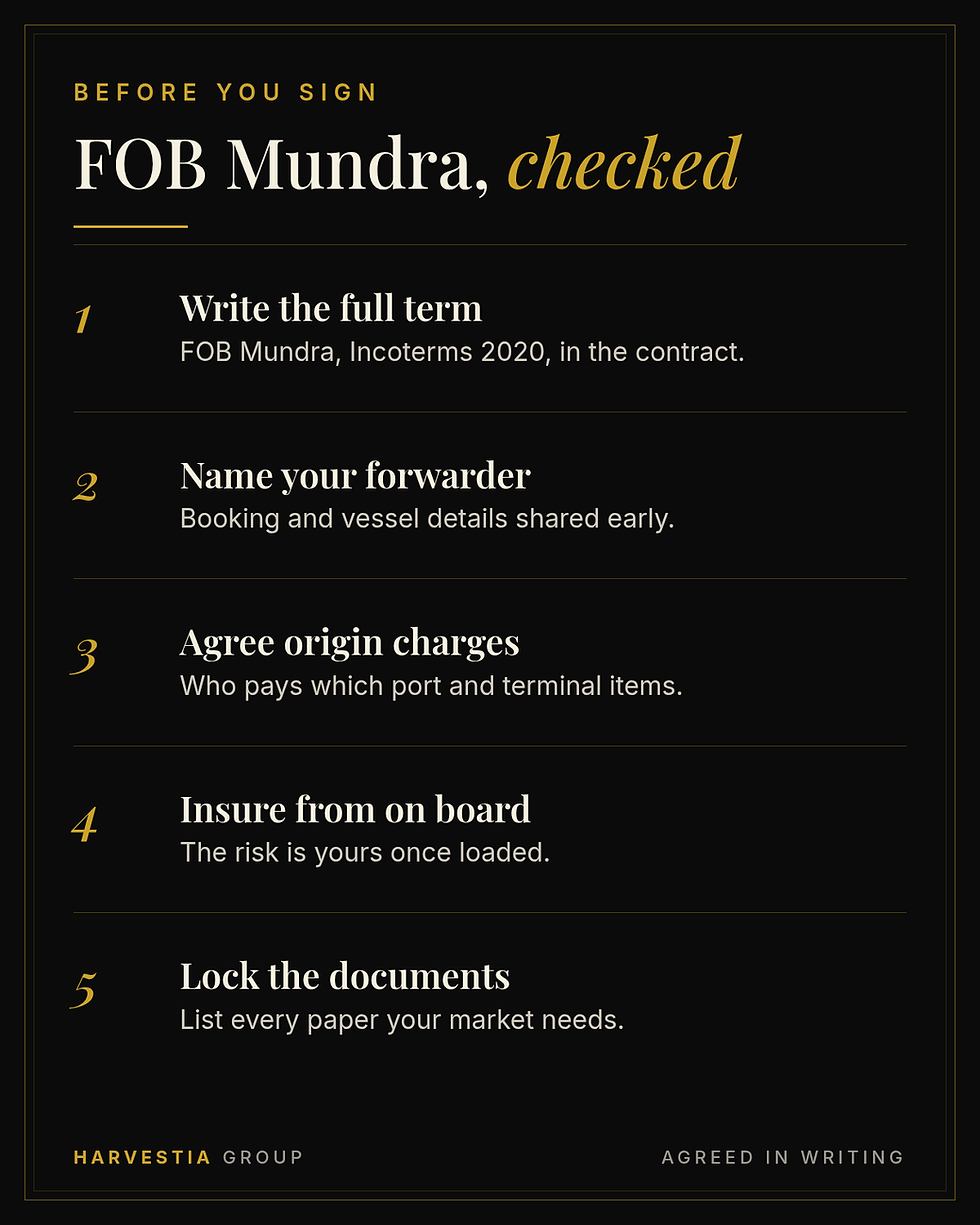
Write the full term: FOB Mundra, Incoterms 2020.
Name your forwarder and share booking and vessel details as early as possible.
Get a written list of origin port and terminal charges, and agree who pays each one.
Arrange cargo insurance that starts when the goods are on board at Mundra.
Agree the document list, including certificate of origin type and any phytosanitary or health certificates your market needs.
Attach your specification and the COA parameters you expect with each commercial lot.
Agree what happens if your vessel is delayed or closes early, since the risk can move to you.
Confirm payment terms separately; FOB does not cover them.
Our spice exporter India sourcing guide puts this checklist in the wider context of choosing and qualifying a supplier.
How Harvestia ships FOB Mundra

Step | What happens |
|---|---|
1 Source | A clear supply chain from ground level farming families, with about 8,000 farming members across India helping maintain quality. |
2 Quality control | Lots checked against your specification and approved sample, with a COA on commercial lots. |
3 Pack under your brand | We process and supply, and pack under the buyer's brand in the format you approve. |
4 FOB Mundra | Export cleared in India and delivered on board at Mundra, with documents coordinated with your forwarder. |
Start small. Samples from Rs 250 and pilot runs from 50 kg let you test the product, the pack and the paperwork before larger volumes. Tell us your destination and your forwarder, and we will line up the document list with them.
Keep reading
FAQs
What does FOB Mundra mean?
FOB Mundra means the seller clears the goods for export and delivers them on board the buyer's nominated vessel at Mundra port in Gujarat. Risk and further costs pass to the buyer once the goods are on board, under ICC Incoterms 2020.
When does risk pass to the buyer under FOB Mundra?
Risk passes when the goods are on board the vessel at Mundra. It can pass earlier if the buyer fails to give vessel notice or the vessel arrives late or closes for cargo early, provided the goods are clearly identified for the contract.
Who pays sea freight and insurance under FOB?
The buyer pays sea freight. FOB puts no insurance duty on either party, but because the risk is the buyer's from on board, buyers usually arrange their own cargo insurance.
Who handles export customs clearance in India under FOB?
The seller does. The shipping bill is filed electronically on ICEGATE, usually through a customs broker, and customs issues a Let Export Order before loading.
Who pays origin terminal handling charges under FOB Mundra?
It depends on the carrier tariff and the contract. Under FOB the seller pays costs until the goods are on board, but container port items vary, so list each origin charge in writing and agree who pays it.
What documents come with an FOB Mundra spice shipment?
Typically a commercial invoice, packing list, shipping bill, bill of lading, certificate of origin and a COA, plus a phytosanitary certificate or other papers where the destination requires them.
Is FOB or CIF better for spice imports?
It depends on how much control you want. FOB gives you control of freight and sailings; CIF puts freight and minimum insurance with the seller. Under both, risk passes on board at the port of shipment.
Can I start with a small FOB Mundra order?
Yes. Harvestia offers samples from Rs 250 and pilot runs from 50 kg, so you can test the product, pack and documents before a full commercial lot.
Ready to plan an FOB Mundra shipment?
Send your spices, specification, destination, forwarder and estimated volumes. We will come back with a clear next step: samples, a pilot, or a quote with the term and document list spelled out.
Prefer email? Write to sales@harvestiagroup.com with your product, destination, pack format and volumes.
Disclaimer: this article is commercial guidance only. It is not legal, customs or regulatory advice. Incoterms 2020 is cited by name; check the ICC text and confirm documents, charges and requirements with your forwarder, customs broker and advisers.
Harvestia Group, Ahmedabad, Gujarat, India | sales@harvestiagroup.com | www.harvestiagroup.com


Comments