
How to Start a Spice Brand in India: The Complete 90-Day Playbook (2025)
- harvestia group
- Feb 5
- 26 min read
In continuation of the previous blog

Chapter 10: Early Scaling Discipline — Why Growth Is Where Most Brands Die
The Illusion of “Momentum”
After launch, something dangerous happens.
Orders start coming in, Instagram engagement improves, Friends say, “It’s really picking up!”, Founders interpret this as proof of success.
In reality, this phase is the most fragile stage of the entire business.
This chapter exists to explain one uncomfortable truth:
Early traction is not validation. It is stress testing.

What “Scaling” Actually Means (And What It Does Not)
Common Founder Misconception
Most founders think scaling means:
More orders
More SKUs
More ads
More cities
More visibility
This is not scaling.
This is expansion.
Definition: Scaling
Scaling is increasing revenue without proportionally increasing operational risk, cost leakage, or quality degradation.
If your costs, errors, complaints, and chaos increase at the same rate as revenue, you are not scaling. You are accelerating toward collapse.
Why Food Businesses Break During Early Growth
Food businesses are uniquely vulnerable because:
Errors are irreversible (once consumed)
Trust compounds slowly but breaks instantly.
Quality variation is immediately noticed.
Compliance exposure increases with volume.
A mistake in 10 orders is feedback.
The same mistake at 1,000 orders is a reputation crisis.
The “False Green Zone” Problem
Early growth creates a deceptive phase where:
Revenue is increasing
Cash is moving
Confidence is high
But underneath:
Margins are unclear
Processes are informal
Quality control is reactive.
Inventory planning is guesswork.
This is the false green zone; everything looks healthy until one pressure spike breaks the system.

Scaling Readiness: The Three Gates
Before scaling anything, you must pass three non-negotiable gates.
Gate 1: Product Consistency
Definition:
The ability to deliver the same sensory experience across batches, months, and volumes.
This includes:
Flavour intensity
Aroma profile
Grind size
Colour
Freshness perception
If customers notice a variation, trust erodes faster than you can fix it.
Gate 2: Operational Repeatability
Definition:
The ability to execute the same processes with minimal decision-making.
Ask yourself:
Can someone else place orders without asking you?
Can fulfilment happen without your intervention?
Can complaints be resolved using a system, not memory?
If the business collapses when you step away, it is not ready to grow.
Gate 3: Economic Clarity
Definition:
Knowing exactly how much you earn, lose, or risk per unit.
This means:
True landed cost per SKU
Channel-wise margins
Marketing ROI (not just revenue)
Cash conversion cycle clarity
Growth without economic clarity is gambling.
Why Adding SKUs Too Early Is Fatal
New SKUs create:
Inventory fragmentation
Cash lock-in
Quality dilution
Focus loss
Founders add SKUs to:
Look bigger
Feel innovative
Please edge cases
But early businesses don’t need variety; they need depth.

Geographic Expansion: The Silent Killer
Serving a new city means:
New logistics variables
New storage conditions
New delivery partners
New customer expectations
Scaling geography before stabilizing operations multiplies failure points.
Marketing During Early Scale: Precision Over Volume
More ads do not fix weak operations.
Early scaling marketing should:
Target repeat buyers
Strengthen trust signals
Improve education, not hype
Aggressive acquisition exposes backend weaknesses faster.
Hiring Too Early vs Hiring Too Late
Too Early Hiring:
Burns cash
Creates confusion
Hides inefficiencies
Too Late Hiring:
Overloads founders
Creates burnout
Increases error rates
The correct approach:
Hire when systems exist, not before
Hire for reliability, not brilliance.
Founder Psychology During Early Scale
This phase tests:
Ego control
Patience
Discipline
Most founders fail here because:
They chase validation
They fear slowing down.
They confuse movement with progress.
The market rewards restraint, not noise.
Scaling Signals You Should Watch (Not Revenue)
Track:
Repeat purchase interval
Complaint ratio
Batch rejection frequency
Inventory ageing
Cash buffer health
These predict survival better than topline growth.
The “One Lever at a Time” Rule
Never scale more than one variable simultaneously:
Don’t add SKUs while expanding cities.
Don’t increase ads while changing suppliers.
Don’t enter retail while fixing D2C operations
Complexity compounds non-linearly.
When You Are Actually Ready to Scale
You are ready when:
Customers return without reminders.
Complaints are rare and predictable.
Operations run without heroics.
Margins are boring but stable.
Scaling should feel anti-climactic, not exciting.
Chapter 11: Building Repeat Purchase Systems — Where Real Brands Are Born
Why First Sales Mean Nothing
A first sale proves only one thing:
Someone was curious once.
It does not prove:
Trust
Satisfaction
Habit formation
Brand loyalty
In food businesses, especially spices, repeat purchase is the only real validation.
If customers do not come back on their own, your business is leaking silently.

Definition: Repeat Purchase
Repeat purchase is a customer choosing you again without needing persuasion, discounts, or reminders.
Anything else is forced retention, not loyalty.
Why Repeat Purchase Is Harder in Spices Than Other Categories
Spices create unique challenges:
Low daily visibility (used, not seen)
Slow consumption cycles
Strong existing habits
High switching inertia
This means:
You must earn loyalty quietly.
You cannot rely on novelty.
You must win on reliability.
The Repeat Purchase Flywheel
Repeat purchase is not one action. It is a system with five interdependent layers:
Product Experience
Usage Outcome
Memory & Recall
Replenishment Timing
Frictionless Re-ordering
If even one layer fails, the loop breaks.

Layer 1: Product Experience (Beyond “Good Quality”)
Definition: Product Experience
Product experience includes:
Aroma on opening
Grind texture during cooking.
Colour release in oil or water
Taste consistency across uses.
Shelf stability over weeks
Customers may not articulate these, but they feel them.
Inconsistency here destroys repeat behaviour silently.
Layer 2: Usage Outcome (Did It Do Its Job?)
Customers judge spices by:
Final dish outcome
Consistency across recipes
Predictability in results
If the spice requires adjustment every time, it creates cognitive fatigue.
Reliable outcomes create subconscious preference.
Layer 3: Memory & Recall Formation
People don’t repurchase what they don’t remember.
Memory is built through:
Distinct aroma
Visual packaging recall
Emotional cooking moments
Brand name simplicity
Your spice must leave a mental trace, not just a taste.
Layer 4: Replenishment Timing
Why Timing Matters
If customers realize they’re out of spice:
Mid-cooking
Mid-week
In a hurry
They buy what is nearest, not what they love.
Your job is to:
Predict consumption
Surface reminders before urgency
Stay top-of-mind
Layer 5: Frictionless Re-ordering
Repeat purchase collapses if:
The website is slow
SKU is out of stock
Login is required
Price changed unexpectedly
Re-ordering must feel easier than switching.
Why Discounts Kill Repeat Purchase Long-Term
Discounts:
Train price sensitivity
Destroy baseline value
Delay repurchase behaviour
Attract disloyal customers
True repeat buyers return without incentives.
Subscription Models: Misunderstood but Powerful
Subscriptions only work if:
Consumption is predictable
Quality is trusted
Delivery is reliable
Subscriptions do not create loyalty.
They monetize existing trust.
Customer Support as a Retention Tool
Support is not damaging control. It is a trusting reinforcement.
How you handle:
Late delivery
Minor defects
Confusion
Determines whether customers forgive or abandon you.
Building Habit Without Noise
Habit formation comes from:
Consistency
Reliability
Absence of friction
Not from:
Daily emails
Constant promotions
Forced engagement
Silence + reliability beats noise + inconsistency.
Measuring Repeat Purchase Correctly
Ignore:
Email open rates
Loyalty sign-ups
Track:
Time to second order
% of customers ordering without discounts
SKU repeat depth
Churn after the second purchase
These reveal real brand strength.

Founder Mistake: Chasing New Customers
Acquisition feels productive.
Retention feels slow, but a business that cannot retain will never scale sustainably.
Fix retention before acquisition.
Repeat Purchase Is a Reflection of Discipline
If customers don’t return, the reason lies in:
Quality inconsistency
Operational friction
Misaligned expectations
Not in “lack of marketing”.
Chapter 12: Quality Control as a Competitive Moat — Winning Without Being Loud
Why Quality Control Is Invisible Until It Fails
Customers rarely praise quality explicitly.
They say things like:
“It tastes the same every time.”
“I don’t have to think about it.”
“It just works.”
What they are really describing is the absence of problems.
Quality control (QC) exists to ensure nothing goes wrong often enough to be noticed. And because it is invisible when done well, founders frequently underestimate its strategic value.
In reality, quality control is one of the strongest competitive moats in the spice business because most competitors do it inconsistently or too late.
Defining Quality Control (Beyond the Obvious)
Quality control is not:
Checking samples occasionally
Trusting your manufacturer blindly
Assuming “same supplier = same quality”
Quality control is:
A system that ensures every batch delivered to a customer meets the same safety, sensory, and performance standards regardless of time, volume, or external conditions.
It is about repeatability under stress.
Why Spices Are Exceptionally Sensitive to QC Failure
Spices are biologically unstable products.
They are affected by:
Climate variation
Seasonal harvest differences
Moisture absorption
Grinding heat
Storage conditions
Packaging integrity
This means that quality naturally wants to drift.
Without controls, variation creeps in quietly:
Aroma weakens
Colour dulls
Taste flattens
Shelf life shortens
Customers may not complain immediately. They stop returning.
The Three Dimensions of Quality Control
Effective QC in spices operates across three interconnected dimensions:
Safety
Sensory Consistency
Compliance Integrity
Ignoring any one of these weakens the entire system.

1. Safety: The Non-Negotiable Foundation
What “Safety” Really Means in Spices
Safety is not just about obvious contamination.
It includes:
Microbial limits (bacteria, mould)
Pesticide residue levels
Heavy metals
Foreign matter (stones, husk, dust)
Moisture content
Spices are agricultural products. They pass through:
Farms
Open drying environments
Transport
Storage
Processing
Each stage introduces risk.
Why Small Brands Are at Higher Risk
Smaller brands often:
Source from aggregators
Buy smaller quantities
Lacks direct farm-level control
This makes incoming raw material testing critical, even if the supplier is “trusted”.
Trust without verification is not a system.
2. Sensory Consistency: The Silent Brand Promise
Defining Sensory Consistency
Sensory consistency means:
Same aroma intensity
Same colour release
Same taste profile
Same cooking behaviour
…across all batches.
Customers may not describe it analytically, but they feel deviation immediately.
Why Sensory Drift Happens
Common causes include:
Different crop origins
Seasonal variation
Changes in drying duration
Grinder temperature fluctuation
Batch size changes
None of these is visible on the label, but all of them affect perception.
The Cost of Inconsistency
Inconsistent spices create:
Cognitive load (“How much should I add this time?”)
Cooking anxiety
Loss of confidence
Once confidence drops, loyalty collapses.
3. Compliance Integrity: Legal Quality
Compliance Is a Form of Quality
Compliance ensures that:
What you claim is provable.
What you sell is defensible.
What you print is accurate.
Incorrect declarations, intentional or accidental, turn quality into a liability.
Examples:
Overstated shelf life
Incorrect ingredient percentages
Missing allergen disclosures
Misleading “natural” or “pure” claims
These are not marketing issues. They are legal exposures.
Building a Practical Quality Control System
Quality control must be lightweight but disciplined, especially for early-stage brands.
Overengineering creates paralysis. Under engineering creates risk.
The goal is controlled reliability.

Step 1: Incoming Raw Material Checks
Before processing, verify:
Visual cleanliness
Aroma strength
Moisture presence
Foreign matter
Basic rejection criteria must exist even if informal.
If you accept everything, you control nothing.
Step 2: Batch-Level Documentation
Every batch should be traceable by:
Date
Supplier lot
Quantity
Conditions
Packaging run
This allows you to:
Identify patterns
Isolate problems
Respond to complaints confidently.
Documentation is memory for the business.

Step 3: Retention Samples
Always retain a small sample from each batch.
Retention samples allow:
Comparison over time
Complaint investigation
Shelf-life observation
Without retention samples, every issue becomes speculation.
Step 4: Periodic Lab Testing (Not Overkill, Not Neglect)
You do not need to test every batch exhaustively.
But you must:
Test at defined intervals
Rotate SKUs
Document results
Testing is not about fear. It is about proof.
Step 5: Supplier Accountability
Suppliers must understand:
You are tracking quality.
You notice a variation.
You expect consistency
This changes behaviour.
Suppliers respect brands that measure.
QC as a Competitive Advantage (Not Just Risk Control)
Most spice brands compete on:
Price
Packaging
Storytelling
Very few compete on reliability.
Reliability creates:
Fewer returns
Higher repeat rate
Lower support burden
Strong word-of-mouth
Over time, QC reduces cost, not increases it.
Founder Psychology: Why QC Is Often Avoided
Founders avoid QC because:
It feels slow
It feels unsexy
It does not create visible growth.
It exposes uncomfortable truths.
But avoiding QC does not avoid problems.
It delays them until they are expensive.
Quality Control and Scale
As volume increases:
Variation increases
Risk multiplies
Consequences amplify
Brands that build QC early:
Scale calmly
Handle pressure better
Recover faster from mistakes.
Brands that delay QC:
Panic under growth
React emotionally
Bleed trust
Chapter 13: Inventory, Freshness & the War Against Stale Stock
A complete operational explanation of the most underestimated risk in spice businesses
1. What Inventory Really Means (Full Definition)
In most beginner conversations, inventory is casually referred to as “stock”.
This is dangerously incomplete.

Inventory (Operational Definition)
Inventory is any physical material that you have paid for but which has not yet generated revenue.
In a spice business, inventory includes:
Raw inventory
Whole spices (turmeric fingers, cumin seeds, coriander seeds, etc.)
Sourced from farmers, mandis, traders, or aggregators
Still unprocessed
Work-in-progress inventory
Cleaned but not ground
Ground but not blended
Blended but not packed
Finished goods inventory
Fully packed retail SKUs
Sitting in:
Your warehouse
A 3PL
Amazon FBA
Distributor godowns
Retail store shelves
Returned or unsold inventory
Customer returns
Expired marketplace stock
Damaged or slow-moving SKUs
Why This Definition Matters
Every category of inventory:
Locks cash
Ages chemically
Carries quality risk
Reduces flexibility
If you only think of “inventory” as packed products, you are blind to where freshness and money are already being lost.

2. Freshness — The Actual Product You Sell
Customers do not consciously buy:
Turmeric powder
Chilli powder
Garam masala
They buy performance in cooking.
Freshness (Functional Definition)
Freshness is the ability of a spice to deliver its expected sensory impact when used in food.
This includes:
Aroma release
Colour intensity
Taste sharpness
Cooking responsiveness
Freshness is not about:
Date of manufacture alone
Legal shelf life alone
“Looks fine” assessment
Freshness is chemical and sensory vitality.
3. Why Spices Lose Freshness (Scientific Reality)
Spices are volatile organic compounds trapped inside plant material.
Freshness degrades due to:
1. Time
Volatile oils evaporate gradually, even in sealed packs.
2. Oxygen
Oxidation dulls aroma and taste.
3. Moisture
Moisture causes:
Aroma loss
Clumping
Microbial risk
4. Light
UV light degrades colour pigments and oils.
5. Heat
Heat accelerates all degradation reactions.
This means:
Freshness is constantly decaying, even if the product is “safe”.
4. Shelf Life vs Freshness (Critical Distinction)
Shelf Life (Legal Definition)
Shelf life is:
The maximum period during which a food product is considered safe for consumption under defined storage conditions.
Shelf life:
Is determined through lab testing
Is a regulatory declaration
Protects consumer safety
Protects the company legally
Freshness (Customer Definition)
Freshness is:
How well the spice performs before the shelf life ends.
A spice can be:
Within shelf life
Fully compliant
Legally safe
…and still be sensory disappointing.
Customers do not forgive “still safe”.
They judge:
Taste
Aroma
Cooking result
5. Inventory Ageing (What Actually Happens Over Time)
Inventory ageing means:
The progressive loss of product value as time passes.
Ageing causes:
Reduced aroma
Flattened flavour
Lower cooking impact
Increased customer dissatisfaction
Reduced repeat purchase
Importantly, ageing is invisible on dashboards unless you track it intentionally.
6. Inventory as a Cash Flow Mechanism
How Inventory Locks Cash
When you buy spices:
Cash leaves immediately
Revenue returns only when sold.
Between these two moments:
Cash is frozen
Expenses continue
Risk increases
Inventory is not idle money.
It is money exposed to decay.
7. Inventory Turnover (Core Metric Explained)
Inventory Turnover Definition
Inventory turnover measures:
How many times is your inventory sold and replaced over a period?
Simple meaning:
High turnover = fresh stock, healthy cash
Low turnover = stale stock, trapped capital
Low turnover is the silent killer of spice brands.
8. Overproduction — The Most Common Founder Mistake
Founders overproduce because:
Per-unit cost looks cheaper.
Suppliers push MOQs
Optimism bias exists
Growth expectations are inflated.
Why Overproduction Backfires
Overproduction leads to:
Slower selling
Longer storage
Freshness loss
Discount dependence
Brand erosion
Cheaper production cost does not matter if:
The product sells late.
Or sells poorly

9. FIFO (First-In, First-Out) Explained Properly
FIFO Definition
FIFO means:
The first batch produced must be the first batch sold.
FIFO ensures:
Oldest stock exits first.
Freshness degradation is minimized.
Expiry risk is reduced.
FIFO Is Not Automatic
FIFO fails when:
Batches are not labelled.
Warehouses mix cartons
Marketplaces ship randomly
Returns re-enter circulation
FIFO must be designed, not assumed.
10. SKU Proliferation and Its Hidden Damage
SKU (Stock Keeping Unit) Definition
An SKU is a unique product variation (size, flavour, blend).
Example:
Turmeric 100g = 1 SKU
Turmeric 200g = another SKU
Why Too Many SKUs Hurt Inventory
Each SKU:
Needs minimum stock
Moves slower
Ages independently
More SKUs = lower velocity per SKU.
Low velocity = stale stock.
Early brands should:
Focus on a few SKUs
Maximise turnover
Expand only after velocity is proven.

11. Storage Conditions (Often Ignored, Always Costly)
Proper Storage Means:
Controlled temperature
Low humidity
Minimal light exposure
Sealed containers
Improper storage:
Cancels good sourcing
Degrades aroma
Reduces shelf life
Warehouse discipline is part of product quality.
12. Marketplace Inventory Risk (Amazon, etc.)
Marketplaces add:
Long storage periods
Limited batch control
Mixed inventory pools
Slow-moving listings
Founders lose visibility once stock enters FBA.
This creates:
Ageing without awareness
Dispatch unpredictability
Return reintegration risk
Marketplace inventory must be actively monitored, not forgotten.
13. Discounting as a Symptom (Not a Solution)
Discounting Definition
Discounting means:
Selling below the intended price to move slow inventory.
Occasional discounting is tactical.
Frequent discounting is a structural failure.
Why Discounting Is Dangerous in Spices
It:
Signals a low value
Trains price sensitivity
Attracts deal-seekers
Reduces trust
Customer's question:
“Why is this spice always on offer?”
14. Inventory Write-Offs (The Hardest Decision)
Sometimes inventory must be:
Destroyed
Written off
Removed from circulation
This is painful, but:
Protects brand trust
Prevents repeat damage
Resets discipline
Selling compromised stock saves money short-term and kills brands long-term.
15. Inventory Discipline as Brand Protection
Customers never see:
Your warehouse
Your batch records
Your FIFO system
But they experience:
Taste consistency
Aroma strength
Cooking reliability
Inventory discipline is felt, not seen.
PHASE 3: LAUNCH, EARLY SALES & SURVIVAL
(DAYS 61–90)
A complete operational decoding of what actually happens after “going live.”
What Phase 3 Really Is (Correct Definition)
Most founders believe Phase 3 is launch + marketing.
This is incorrect.
Phase 3 (Operational Definition)
Phase 3 is the period where your business is exposed to real customers, real cash movement, real feedback, and irreversible reputation signals.
This is the phase where:
Assumptions meet behaviour
Systems meet stress
Confidence meets consequences
Up to Phase 2, mistakes are private, In Phase 3, mistakes become public and permanent.
CORE PURPOSE OF PHASE 3
Phase 3 exists to answer only one question:
“Does this business deserve to survive its first year?”
Survival is not about:
How much do you sell
How fast you grow
How good the website looks
Survival is about:
Repeat behaviour
Cash discipline
Controlled learning
Trust preservation
CHAPTER 14: Launching Without Self-Sabotage
14.1 What a “Launch” Really Is
And why the popular definition is dangerously wrong
Most first-time founders treat a launch as a moment.
A date, a post, a website is going live at midnight. An announcement to friends and family.
This mental model comes from:
Tech startups
Fashion drops
Influencer brands
Digital products
Food businesses do not operate under those rules.
Launch — Correct, Functional Definition
A launch is the first time your product enters someone else’s private space under your brand name.
For spices, this means:
Entering a kitchen
Entering a family’s daily meals
Entering repeated consumption cycles
Entering judgment that is sensory, not intellectual
Once this happens, three things become irreversible:
First impressions
Taste memory
Trust association with your brand name
A launch is not publicity it is exposure to consequences.
Why This Definition Matters
If you believe a launch is:
A marketing event → you optimize for attention
A sales event → you optimize for volume
But if you understand a launch as:
The first irreversible interaction between your product and real households
Then you optimize for:
Control
Stability
Consistency
Learning
This difference decides whether your brand survives Year 1.
14.2 Why Launches Are Especially Dangerous in Food Businesses
Food businesses operate under three unforgiving realities:
1. Food Is Judged Instantly
A customer does not need:
Brand education
A second look
An explanation
They smell it, they taste it, they decide.
There is no “it will improve later” forgiveness loop.
2. Food Is Repeated
A bad shirt is worn once and forgotten. A bad spice is used:
Daily
Weekly
Across multiple dishes
Every usage re-confirms or destroys trust.
3. Food Is Shared Verbally
People talk about food:
At dinner tables
In family WhatsApp groups
With neighbours
With cooks and helpers
A weak launch creates offline negative word-of-mouth you will never see but will feel in slow sales.
14.3 The Difference Between a Controlled Launch and a Reckless Launch
Reckless Launch (What Most Founders Do)
Characteristics:
Large announcement
All SKUs live
Full inventory pushed out
Ads turned on immediately
Influencers activated at once
Psychology:
Excitement
Ego
Fear of “missing momentum.”
Result:
Errors scale instantly
Complaints go public
Fixes come too late
Controlled Launch (What Surviving Brands Do)
Characteristics:
Limited exposure
Fewer SKUs
Lower volumes
Select audiences
Tight observation loops
Psychology:
Restraint
Humility
Long-term thinking
Result:
Errors discovered early
Fixes applied quietly
Reputation protected

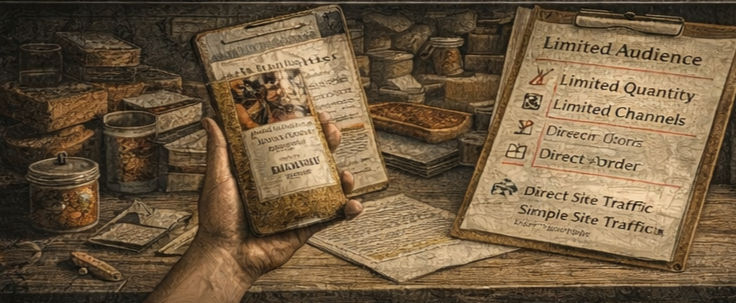
14.4 Soft Launch vs Hard Launch
Soft Launch — Full Definition
A soft launch is a deliberately limited market entry designed to learn, not impress.
It is used to:
Test systems
Validate assumptions
Observe real behaviour
Catch failures before scale
Key Characteristics of a Soft Launch
Limited Audience
Only people you can:
Talk to directly
Ask questions to
Receive honest feedback from
Limited Quantity
Inventory is intentionally small so:
Losses are containable
Quality is closely monitored
Freshness is guaranteed
Limited Channels
Usually:
Direct orders
WhatsApp
Small website traffic
No heavy marketplaces
High Feedback Access
You know:
Who bought
Why they bought
What they experienced
What confused them
What a Soft Launch Is NOT
Not a trial run for marketing
Not a revenue push
Not a brand announcement
Not a discount campaign
A soft launch is a diagnostic phase, not a growth phase.
Hard Launch — Full Definition
A hard launch is unrestricted public exposure.
It signals:
Confidence in systems
Confidence in consistency
Confidence in demand understanding
Characteristics of a Hard Launch
Paid advertising
Influencer amplification
Marketplace push
Larger inventory commitments
Wider geographic reach

The Critical Rule
A hard launch is earned through soft-launch stability.
Scheduling a hard launch without soft-launch learning is equivalent to:
Testing brakes after entering traffic
Debugging after going viral
Fixing recipes after customer complaints
14.5 Why Food Brands Must Launch Quietly
Quiet launches are not about fear they are about risk geometry.
Risk Geometry Explained
Risk in food businesses increases with:
Number of customers
Speed of orders
Distance from the founder
Complexity of logistics
A quiet launch:
Keeps risk surface area small
Allows manual intervention
Enables real-time correction
Loud Launches Create Permanent Damage
In food:
Early reviews stick
Early ratings dominate algorithms
Early reputation shapes retailer trust
You can recover from:
Low sales
You cannot easily recover from:
“Inconsistent quality.”
“Not worth the price.”
“Smells weak.”
“Taste varies batch to batch.”
These labels follow brands for years.

14.6 Controlled Exposure
The Most Important Survival Concept in Phase 3
Controlled Exposure — Precise Definition
Controlled exposure means:
Intentionally limiting how many people experience your product until you are confident in its consistency and delivery.
This is not caution this is a professional discipline.
Dimensions of Exposure You Must Control
1. Quantity Exposure
How many units leave your control?
Early mistake:
Producing too much
Distributing too widely
Correct approach:
Under-supply intentionally
Create artificial scarcity for learning
2. Channel Exposure
Where your product is available.
Early danger:
Marketplaces amplify problems
You lose customer contact
Reviews go public instantly
Early safety:
Direct channels
Traceable customers
Private feedback loops
3. Geographic Exposure
How far your product travels.
Distance increases:
Logistics complexity
Damage risk
Delay
Temperature impact
Early launches should be geographically tight.
4. Customer Type Exposure
Who experiences your product first.
Early customers should be:
Patient
Curious
Quality-sensitive
Willing to talk
Avoid early exposure to:
Discount hunters
Price-only buyers
Comparison shoppers
They punish new brands harshly.
14.7 Why Restraint Is a Competitive Advantage
Most founders equate speed with intelligence.
In food businesses:
Speed amplifies errors
Restraint amplifies learning
The founders who survive:
Delay gratification
Resist ego launches
Protect early trust fiercely
14.8 The Psychological Trap of “Going Live.”
Going live feels like:
Validation
Progress
Momentum
But emotionally satisfying actions are often strategically destructive.
A disciplined founder asks:
“What can break?”
“What will customers misunderstand?”
“What will go wrong silently?”
A reckless founder asks:
“How do I get more orders?”
CHAPTER 15 : Early Marketing With Discipline
Why marketing in food businesses is not about hype it is about trust, education, and structured attention
15.1 What Early Marketing Really Means
Many first-time founders misunderstand marketing. They think marketing is:
Ads on Instagram or Facebook
A launch post with an influencer
Fancy packaging photos
This is superficial marketing, or marketing as “noise.”
Early marketing, in a food business, is fundamentally different. It is the set of intentional, small-scale, trust-building actions that:
Introduce the brand to real customers
Educate them about the product and its value
Encourage trial without overwhelming
Protect the brand from irreversible mistakes
Think of early marketing as preparing the market to welcome your product, not forcing it in.
Key Principle
In food marketing, without discipline, mistakes. Marketing is a force multiplier; if your product is weak, it spreads weakness. Marketing is a trust amplifier; if your product is strong and your communication is disciplined, it strengthens adoption.
15.2 Teach Before You Sell
Definition
“Teach before you sell” is a principle that prioritizes education over conversion in the early stage.
In spices, customers do not always understand differences in:
Aroma
Freshness
Sourcing
Regional authenticity
Adulteration risks
Selling without teaching assumes knowledge that the customer may not have. This can backfire.

Components of Teaching in Early Marketing
Ingredient Transparency
Explain where spices come from
Highlight sourcing ethics
Describe quality checks
Usage Education
Show how to use the spice for the best aroma and taste
Include portion guidance
Recommend storage tips
Trust Signals
FSSAI certification
Lab testing results
Packaging information (e.g., oxygen barrier, freshness seals)
Cultural or Emotional Connection
Explain the regional relevance of a spice
Stories of traditional cooking
Why This Matters
Without teaching:
Customers buy once and may not repeat
They assume they understand your product and feel disappointment if it doesn’t meet expectations
Social sharing can spread confusion instead of advocacy
With teaching:
Customers are informed, set correct expectations, and value your expertise
First-time trials are more likely to convert to repeat purchases
Early adopters become brand ambassadors
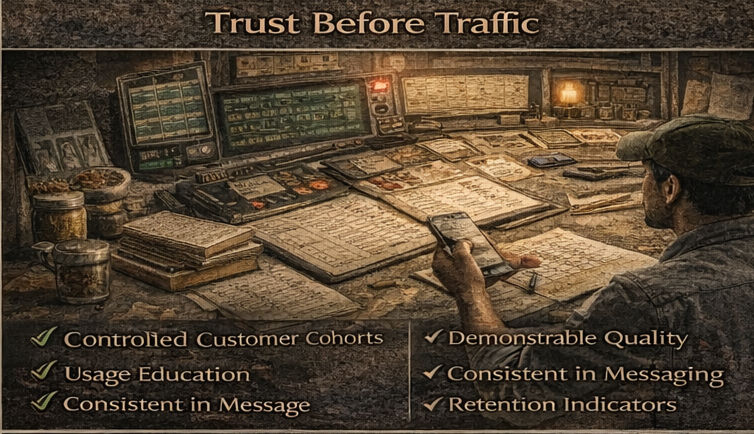
15.3 Trust Before Traffic
Definition
“Trust before traffic” means don’t try to attract everyone until your product, processes, and messaging are ready.
Early marketing often prioritizes metrics like:
Follower count
Website visits
Likes and shares
But in food businesses, quantity of exposure without quality leads to:
Negative reviews
Brand scepticism
Unrecoverable word-of-mouth damage
Building Trust First
Controlled Customer Cohorts
Start with small, reliable groups: friends, family, small online communities, and early testers
Collect detailed feedback
Demonstrable Quality
Let customers experience actual product superiority
Use sensory marketing (photos, videos, demos) to communicate experience
Consistency in Messaging
Messaging should match product experience
Avoid hype; overpromising destroys credibility
Practical Example
Imagine launching turmeric:
Don’t post “world’s purest turmeric” without proof
Teach: origin, aroma, colour, and shelf-life testing
Deliver small packs to early customers and document their experience
Collect testimonials and reviews that are factual, not inflated
This sequential trust-building ensures that when traffic grows, it finds a brand that can withstand scrutiny.
15.4 The Funnel Mindset in Early Marketing
Definition
A marketing funnel is the journey a potential customer takes from first awareness to purchase and then loyalty.
In early food marketing:
Awareness – People notice your brand
Consideration – They understand what makes it different
Trial – They try your product in a low-risk, controlled way
Adoption – They become repeat customers
Key Principle
In early-stage food businesses, the top of the funnel is irrelevant without the bottom.
Traffic, likes, and followers do not matter if you fail to convert first-time trial into repeat usage.
Applying Funnel Discipline
Prioritize repeatable touchpoints over virality
Ensure feedback loops after every trial
Delay scale until repeat purchase behaviour is observed
This prevents wasted marketing spend and protects early brand reputation.
15.5 Channels in Early Marketing — What Works
1. Direct Channels
WhatsApp, SMS, email to small, curated lists
Enables personal follow-ups and detailed feedback
Example: send spice samples to 20–50 early adopters and document results
2. Controlled Social Presence
Instagram, X/Twitter, or YouTube with a small reach
Focus on educational content: how-to-use, sourcing transparency, cooking tips
Avoid paid ads until systems and repeatability are proven
3. Word-of-Mouth and Community
Encourage early adopters to share results within their trusted circle
Reward honest feedback, not just promotion
Build a community of informed users, not followers

Channels to Avoid Early
Large-scale paid campaigns
Influencer amplification without control
Broad marketplaces that generate anonymous traffic
These amplify mistakes instead of building trust.
15.6 KPIs for Early Marketing
Definition
KPIs (Key Performance Indicators) are specific metrics that measure success.
Early marketing KPIs in food businesses differ from those of typical startups:
Trial-to-Repeat Ratio
How many first-time buyers come back?
Measures product acceptance
Customer Feedback Quality
Number of actionable insights collected per 10 trials
Conversion in Controlled Channels
% of direct messaging leads that place first orders
Retention Indicators
How long does a customer stay with the brand before switching back?
Focus on these over vanity metrics like:
Likes, shares, impressions
Follower count
“Hype” or trendiness
15.7 Common Mistakes in Early Marketing
Rushing to scale
Leads to high exposure of untested products
Over-promising in ads or posts
Destroys trust permanently
Ignoring feedback
Missed learning opportunities
Copying competitors blindly
Competitor success may not translate to your unique context
15.8 Discipline as a Marketing Strategy
Marketing discipline means restrained, intentional, data-driven actions.
Key tenets:
Limit exposure: soft launch first
Focus on teaching: educate, demonstrate, and clarify
Prioritize trust: ensure every first impression aligns with the promise
Measure behaviour: trial, feedback, repeat purchase, not just clicks
CHAPTER 16: Feedback, Iteration & Repeat behaviour
Why listening, learning, and refining are the heartbeat of a successful spice business.
16.1 Feedback — The Compass of Product Success
Definition
Feedback is the information you receive from customers about their experience, expectations, and perception of your product.
In food businesses, feedback is the single most valuable input, because taste, aroma, and trust cannot be measured purely through metrics or assumptions.
Types of Feedback
Sensory Feedback
Related to aroma, taste, colour, texture
Example: “These turmeric smells weaker than the previous batch.”
Functional Feedback
How the product performs in real-life cooking
Example: “The garam masala clumps in humid conditions.”
Emotional Feedback
How the product makes the customer feel
Example: “Using this spice reminds me of my grandmother’s cooking.”
Operational Feedback
Issues outside sensory perception, like delivery, packaging, or labelling
Example: “The pouch tore during shipping.”
Key Principle
Feedback is data disguised as opinion. In food businesses, customers often express issues emotionally, but beneath the words lie critical insights for improvement.

16.2 Iteration — Learning and Improving Systematically
Definition
Iteration is the process of making small, structured improvements based on feedback and observation.
Iteration is not:
Random experimentation
Changing the packaging design for the sake of novelty
Reacting to every individual complaint
Iteration is:
Systematic
Evidence-based
Repeatable
Iteration in Spice Businesses
Recipe Iteration
Adjust spice ratios, grinding methods, or roasting levels based on feedback
Ensure changes are documented and tested
Packaging Iteration
Upgrade barrier properties, reseal designs, or pouch usability
Test before rolling out to the next batch
Operational Iteration
Refine delivery, storage, and labelling processes
Minimize damage, delays, or confusion
Marketing Iteration
Refine messaging, educational content, and visuals based on engagement and comprehension
Avoid over-promising
Key Principle
Iteration preserves trust while improving products and systems. Inconsistent iteration, or ignoring feedback, erodes brand credibility.

16.3 Repeat behaviour — The True Measure of Success
Definition
Repeat behaviour is the act of customers buying your product more than once.
In spice businesses, repeat purchase is the ultimate KPI, because:
Spices are habitual, low-involvement products
One-time purchases do not validate product quality or brand trust
Early sales without repeat behaviour can mask underlying problems
Understanding Repeat behaviour
Frequency of Use
How often does the customer use the spice in daily or weekly cooking?
Frequent use accelerates trust cycles
Purchase Regularity
How often does a customer reorder?
Measures convenience, satisfaction, and reliance
Brand Loyalty vs. Product Loyalty
Some customers may buy only for functional needs, switching brands easily
True repeat behaviour occurs when customers buy your brand specifically, not just the spice category
Key Principle
If customers do not return, marketing, packaging, and pricing cannot save you. Repeat behaviour is proof that your product delivers on its promise.

16.4 Feedback Loops — Closing the Knowledge Gap
Definition
A feedback loop is a structured method of collecting, analysing, and acting upon feedback continuously.
Feedback loops ensure that every complaint, comment, or observation leads to measurable improvement.
Components of a Strong Feedback Loop
Collection
Surveys, direct messages, WhatsApp conversations, reviews
Encourage honesty, not flattery
Analysis
Look for patterns, not isolated opinions
Identify high-impact issues first
Action
Implement small, measurable changes
Document changes to avoid confusion
Communication
Inform customers when their feedback led to improvement
Builds trust and community
Key Principle
Feedback loops are the operational backbone of customer-centric spice businesses. They convert anecdotal complaints into systematic product and process upgrades.

16.5 Learning from Negative Feedback
Many founders fear negative feedback. In food, this is a critical error.
Why Negative Feedback Matters
Spices are sensory products small defects are immediately noticed
Negative feedback highlights trust risks before they scale
Positive reviews may hide minor but systemic issues
How to Approach Negative Feedback
Listen Objectively
Don’t take it personally
Separate emotion from insight
Categorize Issues
Sensory, functional, operational, emotional
Prioritize Action
Fix what affects repeat behaviour first
Minor aesthetic complaints are secondary
16.6 Continuous Improvement — Building a Culture of Iteration
Iteration is not a one-time task. It is a cultural discipline.
Document every batch, complaint, and adjustment
Use SOPs to institutionalize learnings
Empower team members to notice and report problems
This ensures organizational memory, so the brand does not regress even as staff or suppliers change.
16.7 Metrics to Track Feedback & Repeat behaviour
Repeat Purchase Rate (RPR)
% of first-time buyers who purchase again
Target: 25–40% within first 90 days
Net Promoter Score (NPS)
Will customers recommend your spice to others?
High NPS correlates with word-of-mouth growth
Complaint-to-Sales Ratio
Of complaints per 100 units sold
Measures operational and sensory consistency
Time to Resolution
How quickly feedback is acted upon
Fast resolution protects trust
16.8 Common Mistakes in Feedback & Iteration
Ignoring early complaints as “outliers.”
Changing multiple variables at once, making root causes unclear
Focusing on aesthetic or marketing feedback before functional feedback
Scaling before establishing repeat behaviour
CHAPTER 17: Cash Flow & Inventory Discipline
Why money movement and stock control determine survival in a spice business.
17.1 Cash Flow — The Lifeblood of Your Business
Definition
Cash flow is the movement of money into and out of your business.
It is not the same as profit. A brand can be profitable on paper but still fail if cash is mismanaged.
“Profit tells you if the business is healthy. Cash flow tells you if it lives to see the next month.”
Components of Cash Flow
Cash Inflows
Money coming into the business
Examples:
Customer payments from online or offline sales
Investments or loans
Returns from marketplace credits
Cash Outflows
Money going out of the business
Examples:
Raw materials and spices
Packaging costs
Manufacturing or co-manufacturing fees
Logistics and delivery
Platform fees (Amazon, Flipkart, etc.)
Salaries, rent, utilities

Key Principles
Positive Cash Flow = Survival
Even if your product is loved, you cannot continue operations without money to pay suppliers or employees.
Timing Matters More Than Amount
Receiving ₹1,00,000 after 60 days may not help if you owe suppliers ₹80,000 today.
Cash Flow Forecasting
Predict your inflows and outflows weekly and monthly
Identify potential shortages before they become crises
Common Cash Flow Mistakes
Assuming that revenue = cash in hand
Ignoring delayed payments from marketplaces or distributors
Underestimating costs like logistics surcharges or returns
Using business cash for personal expenses prematurely
17.2 Inventory Discipline — Controlling Your Product Assets
Definition
Inventory discipline refers to how efficiently and accurately you manage your stock, both raw spices and finished products.
In spice businesses, poor inventory discipline can destroy margins, quality, and customer trust.
Key Elements of Inventory Discipline
Stock Levels
Maintain enough to meet demand without overstocking
Overstocking risks:
Spices losing aroma or potency
Capital locked in inventory
Wastage from expired products
Inventory Turnover
Measures how quickly stock is sold and replaced
High turnover → healthy demand & minimal waste
Low turnover → stale stock & cash blockage
Batch Tracking
Each batch should be recorded for:
Manufacture date
Expiry or best-before date
Source of raw material
Grinding & packaging conditions
Critical for recalls, quality checks, and maintaining sensory consistency
Reorder Points
Pre-defined inventory levels triggering new purchase
Prevents stockouts without overstocking
First-Expiry-First-Out (FEFO) / First-In-First-Out (FIFO)
Systematic method to sell older stock before newer stock
Ensures freshness for customers and compliance with regulations
Key Principles
Inventory is Capital, not a Burden
Too much stock locks money and risks quality
Too little stock risks losing sales and broken trust
Consistency Over Size
Better to maintain smaller, consistent batches than huge irregular stockpiles
Documentation is Non-Negotiable
Every incoming raw material, finished pack, and dispatch must be logged
Supports traceability, compliance, and operational efficiency
17.3 The Relationship Between Cash Flow & Inventory
Poor inventory management directly affects cash flow:
Overstock = cash tied up
Understock = lost sales and revenue
Good inventory discipline optimizes cash cycles
Buy only what you can sell in a defined period
Align purchase timing with cash inflows
In spices, aroma and freshness decay faster than most products, so inventory discipline is both a financial and quality imperative.
17.4 Working Capital Management
Definition
Working capital = Current Assets − Current Liabilities
Current assets: cash, inventory, receivables
Current liabilities: payables, short-term debt
Positive working capital ensures the business can cover short-term obligations while continuing operations.
Spice Business Implications
Excessive raw spice stock reduces liquidity
Late payments to co-manufacturers or suppliers can delay production
Balancing inventory and cash is essential for scaling
17.5 Key Metrics for Cash Flow & Inventory
Cash Conversion Cycle (CCC)
Time it takes to convert inventory into cash
Lower CCC → faster cash recovery
Days Inventory Outstanding (DIO)
Average days inventory stays before being sold
Lower DIO → fresher spices, less capital tied up
Days Payable Outstanding (DPO)
Average days to pay suppliers
Longer DPO → better cash management, but avoid hurting supplier relationships
Safety Stock Levels
Extra inventory to account for supply or demand fluctuations
17.6 Common Mistakes in Cash & Inventory Management
Overproduction → aroma and freshness loss, cash tied up
Underestimating demand → missed sales, unhappy customers
Ignoring small costs → logistics, platform fees, sampling, spoilage
Not tracking batches → recall risk, repeat buyer dissatisfaction
Mixing personal and business cash → distorts cash flow visibility
17.7 Systems & Tools to Maintain Discipline
Inventory Management Software
Track batches, expiration, and reorder points
Integrates with e-commerce and accounting
Cash Flow Forecasting Tools
Spreadsheet or software to track inflows/outflows
Include recurring costs, logistics, and ad spends
Regular Audits
Weekly or monthly stock checks
Compare physical stock with records
90-Day Spice Brand Playbook — Quick Summary
Phase 1 (Days 1–30) — Foundation & Validation
You’re building a food business, not just a brand.
Validate the market gap: specific audience, real pain/aspiration, willingness to pay.
Study real competition, not big brands.
Understand unit economics and choose the right business model.
compliance plan (FSSAI, labelling, shelf life) early.
Phase 2 (Days 31–60) — Product & System Readiness
Build repeatable systems for sourcing, grinding, blending, packaging, and testing.
Ensure sensory consistency and shelf-life protection.
Digital presence is a trust infrastructure, not just marketing.
Document everything; sloppy execution kills brands quietly.
Phase 3 (Days 61–90) — Launch & Early Sales
Launch cautiously; use a soft launch to test systems.
Focus on early marketing that builds trust, not hype.
Gather feedback, iterate, and optimize for repeat purchases.
Maintain cash flow and inventory discipline to survive and scale.
Core Principles Across Phases:
Consistency > Creativity
Discipline > Shortcut
Evidence > Emotion
Trust is earned slowly, lost instantly
Patience is strategic


Comments