
How to Start a Spice Brand in India: The Complete 90-Day Playbook (2025)
A definitive, book-style guide for founders who want to build a real spice business, not just launch another brand.
Introduction: Why This Guide Is Written Like a Book
(And Not a Blog)
India has never had a shortage of spices.
It has also never had a shortage of people trying to sell spices.
What India lacks even in 2025 is a large number of well-structured, backend-strong, repeat-driven spice businesses. Every year, hundreds of founders enter this space with genuine intent. Most exit quietly within 12–24 months. Their websites vanish, Instagram pages go inactive, and Amazon listings show “Currently unavailable.”
This guide exists because most advice available online is either:
Overly motivational (“Follow your passion”)
Overly tactical without context (“Run ads”)
Or dangerously incomplete (“Just private label and scale”)
Spices are not a forgiving category. They are regulated, sensory-driven, low-margin at scale, and brutally competitive. At the same time, they are culturally embedded, high-repetition, and deeply trusted products. That combination makes spices both dangerous and powerful.
This is why this guide is written like a book: slow, structured, detailed, and honest.
You are not expected to skim this. You are expected to build from it.

PART I — PHASE 1: FOUNDATION & VALIDATION
(DAYS 1–30)
Chapter 1: Understanding What You Are Really Building
Before we discuss spices, suppliers, or packaging, we must establish clarity on a foundational truth that most first-time founders resist:
You are not building a “spice brand.” You are building a food business that happens to sell spices first.
This distinction is not semantic. It changes how decisions are made, how risks are evaluated, and how success is measured.
A brand can be visual, expressive, and fast-moving. A food business is slow, regulated, repetitive, and unforgiving. Food enters people’s bodies, kitchens, and families. As a result, food businesses are governed by forces that do not apply to fashion, electronics, or drop shipping.
If you approach spices like a lifestyle product, focusing primarily on aesthetics, marketing hacks, or influencer buzz, the market will eventually punish you. Sometimes quietly. Sometimes publicly.
To understand what you are truly building, we must unpack the five governing forces of every successful food business.

1. Trust Cycles
Trust is the primary currency of a food business.
When a customer buys spices, they are making several invisible leaps of faith:
That the product is safe to consume
That it is not adulterated
That it will taste the same next time
That it will not harm their family
Unlike impulse categories, food trust is earned slowly and lost instantly.
A trust cycle refers to the repeated loop of:
First-time trial
Consumption experience
Sensory satisfaction
Absence of negative outcomes
Repurchase
Only after several such cycles does a customer stop “evaluating” you and start habitually buying you.
In spices, this cycle can take months, not days.
This is why food brands cannot rely on one-time virality. A bad batch, inconsistent aroma, or contamination scare can erase years of trust overnight. Conversely, brands that protect trust through quality, honesty, and consistency benefit from long customer lifetimes.
Key implication for founders: Every shortcut that risks quality is actually a trust loan taken at high interest.
2. Regulation
Food businesses do not operate in an open market. They operate inside a regulatory framework designed to protect public health.
In India, this framework is governed primarily by the FSSAI.
Regulation affects:
What you can sell
How do you describe it
How long can it last?
How it must be tested
How it must be labelled
Who is legally responsible
Unlike many other industries, ignorance is not a defence in food.
A missing declaration, an incorrect shelf-life claim, or a mislabelled ingredient can result in:
Marketplace delisting
Monetary penalties
Forced recalls
Brand shutdowns
Regulation is not an obstacle to growth. It is a filter. Brands that respect it survive longer. Brands that treat it as paperwork eventually fail.
Key implication for founders: Compliance decisions must be made before products are finalized, not after they are printed.
3. Repeat Consumption
Spices are not occasional purchases. They are repeat-consumption products.
This has two critical consequences:
Customers notice inconsistency. If today’s turmeric tastes different from last month’s, the difference will be noticed.
Switching costs are low. If disappointment occurs, customers can switch brands on their very next purchase.
Repeat consumption means your product is judged not once, but every time it is used.
Unlike gadgets or apparel, where novelty can mask flaws, spices are exposed daily to scrutiny.
This makes early product discipline essential. You are not optimizing for a good first impression; you are optimizing for the hundredth use.
Key implication for founders: Consistency beats creativity in food businesses.
4. Sensory Consistency
Spices are sensory products. They are evaluated using:
Smell
Taste
Colour
Texture
These are subjective senses, but customer expectations around them are extremely precise.
A customer may not know the chemistry of cumin, but they know when:
Aroma fades faster than usual.
Colour looks dull
Taste feels weaker
Sensory consistency does not happen by accident. It is the result of:
Controlled sourcing
Standardized grinding
Batch-level SOPs
Proper packaging
Inventory discipline
Inconsistent sensory experience is the fastest way to lose repeat buyers.
Key implication for founders: Your brand promise lives in the nose and mouth, not on the label.
5. Backend Discipline
Backend discipline is the invisible engine of a food business.
It includes:
Supplier selection and reliability
Batch documentation
Quality checks
Inventory rotation
Compliance tracking
Cash-flow timing
Most failed spice brands look fine from the outside. The breakdown happens behind the scenes:
Raw material variation
Poor record keeping
Over-ordering inventory
Missed renewals
Cash stuck in stock
Food businesses punish chaos. The reward process.
Key implication for founders: Operational discipline matters more than marketing talent.
Chapter 2: Market Gap Validation — The Difference Between Hope and Strategy
Market gap validation is the moment where aspiration must give way to evidence.
Most founders do not fail because they are lazy or unintelligent. They fail because they confuse personal belief with market truth. This chapter exists to separate the two.
Why “I Like Cooking” Is Not a Business Strategy
Nearly every spice brand begins with a deeply personal story. Common starting points include:
“My family has always used pure spices.”
“I don’t trust supermarket brands.”
“I want to revive authentic flavours from my region.”
These emotions are not wrong. In fact, they are often what push founders to begin at all. But emotion has a specific role in business: it can start the journey, not guide it.
A business strategy cannot be built on personal taste, nostalgia, or frustration alone because the market does not reward intent. It rewards relevance.
When founders rely too heavily on emotion, three dangerous assumptions creep in:
Others feel the same way I do
People will automatically understand my quality.
Good products sell themselves.
In the spice category, all three assumptions are false.
Most households already have a spice brand they trust. Switching requires friction. Emotional conviction does not remove that friction; clear value does.
This is why a market gap must exist outside your emotions. It must be observable, repeatable, and independent of your personal story.

What Is a Market Gap (Properly Defined)
A market gap is not an empty market. Spices are everywhere.
A market gap is a mismatch between what customers want and what existing brands consistently deliver.
In the spice business, gaps rarely appear as:
New ingredients
Revolutionary products
They appear as failures in:
Consistency
Transparency
Trust
Freshness
Relevance to a specific user group
Your job is not to invent demand. It is to identify dissatisfaction or unmet aspirations that already exist.

The Three Properties of a Real Market Gap
A real, commercially viable market gap always has three properties. If even one is missing, the gap is weak or imaginary.
1. Specificity — Knowing Exactly Who You Are For
Specificity means your product is designed for a clearly identifiable group, not for everyone.
Examples of specificity:
Urban families with young children
Home bakers who cook daily
Health-conscious buyers reading labels
Migrants from a particular region
Specificity is uncomfortable because it feels limiting. Founders fear that narrowing the audience reduces opportunity.
In reality, the opposite is true.
Broad positioning creates a weak appeal. Narrow positioning creates strong relevance.
A brand for “everyone” is trusted by no one.
2. Pain or Aspiration — Solving Something That Matters
A gap must address either:
A pain (something customers actively dislike or fear), or
An aspiration (something customers desire strongly)
In spices, common pains include:
Fear of adulteration
Inconsistent taste across batches
Loss of aroma soon after opening
Suspicion about artificial colour or polish
Common aspirations include:
Cooking food that tastes like home
Serving family safer, purer ingredients
Achieving restaurant-like consistency
Preserving cultural or regional identity
If the problem is mild, customers will tolerate it. If it is meaningful, they will switch brands.
Pain and aspiration must be strong enough to justify change.
3. Willingness to Pay — Proof Through Behaviour, Not Words
The most misunderstood property of a market gap is willingness to pay.
Customers saying “this sounds good” is not validation.
Validation occurs when customers:
Already spent money solving the problem, or
Explicitly say they would pay more to solve it better.
In spices, willingness to pay often shows up as:
Buying smaller packs at higher per-gram prices
Choosing premium brands despite cheaper alternatives
From local vendors perceived as trustworthy
If customers are not paying today, you must ask why.
Education alone rarely creates a willingness to pay. The gap must already exist in behaviour.

What a Market Gap Is Not
Many founders mistake market size for market gap.
Statements like:
“Everyone uses spices.”
“India loves food.”
…describe market existence, not opportunity.
They offer no guidance on:
Who to target first
What to improve
What to charge
How to differentiate
Such statements lead to generic products and weak positioning.
The One-Sentence Strategy Test
Strategy begins when confusion ends.
If you cannot describe your business in one precise sentence, you do not yet have a strategy.
Use this framework:
“We help ________ solve ________ by offering ________, unlike ________.”
Each blank must be filled concretely:
Who exactly is the customer?
What problem or aspiration is addressed?
How is your solution different in practice?
Who are you explicitly not like?
If your sentence sounds generic, it means your thinking is still vague.
Rewrite it until it feels slightly uncomfortable. Precision always does.
Why Market Gap Validation Comes First
Without validation:
Pricing becomes guesswork
Marketing becomes expensive
Inventory becomes risky
Branding becomes cosmetic
Market gap validation anchors every future decision.
It turns hope into strategy.
And strategy is the only reliable starting point for a food business.
Chapter 3: Competitive Reality — Studying the Right Enemies
Why This Chapter Exists
Most first-time spice founders misunderstand competition in two dangerous ways:
They fear the wrong competitors
They study competitors in the wrong way
This chapter exists to correct both mistakes.
Competition is not about intimidation. It is about orientation. Until you understand who you are actually competing against, every decision you make, pricing, packaging, messaging, and sourcing will be misaligned.
This is not a chapter about copying competitors. This is a chapter about seeing the battlefield clearly.

Why Big Brands Are Not Your First Enemy
Understanding Scale Asymmetry
Brands like MDH, Everest, Catch, and Tata Sampann operate under conditions that are fundamentally different from yours.
They have:
Decades of brand trust
National distribution networks
Dedicated procurement teams
In-house labs
Advertising budgets larger than your total annual revenue
Negotiation power with distributors and retailers
This is called scale asymmetry, a situation where two players are not even operating in the same game.
Competing with these brands on:
Price
Reach
Shelf dominance
Advertising volume
…is not competition. It is suicide.
Why Founders Still Obsess Over Big Brands
Founders fixate on big brands because:
They are visible everywhere
They define category norms
They feel like “the market leaders.”
But visibility does not equal relevance.
A customer choosing between MDH and Everest is not choosing you. You are not even in their consideration set yet.
Your early-stage battle is not about replacing giants. It is about winning your first 1,000 customers.

Who Your Real Competitors Are (And Why They Are More Dangerous)
Your real competition lives where you will realistically operate in your first 12–24 months.
1. Instagram-First D2C Spice Brands
These brands:
Launch digitally
Sell storytelling, purity, or health
Target urban and semi-urban buyers
Compete heavily on perception
Why are they dangerous:
They speak the same language as you will
They attract the same audience
They set expectations around pricing and presentation, do
They don’t beat you with scale. They beat you with clarity and speed.
2. Amazon & Marketplace Private Labels
Private labels are brands owned by platforms or sellers with:
Marketplace data access
Pricing control
Algorithmic advantages
Minimal branding costs
Why are they dangerous:
They can undercut pricing
They copy fast-moving SKUs
They rank aggressively
They don’t need brand love. They win through visibility and convenience.
3. Strong Regional Players with Loyal Customers
These brands:
Operate in specific states or cities
Have deep cultural trust
Often sell loose or semi-branded spices
Win through familiarity
Why are they dangerous:
Customers already trust them
Switching away feels risky
They are embedded in daily buying habits
They don’t advertise loudly. They survive through habit and heritage.
The Core Principle: Compete Where Customers Actually Compare
Customers do not compare brands logically. They compare what is visible at the moment of buying.
If a customer is:
On Amazon → your competition is Amazon-visible brands
On Instagram → your competition is content-driven brands
In a Kirana store → your competition is shelf-neighbour brands
Competition is contextual, not theoretical.

How to Study Competition Properly
Competitive research is not about collecting logos or prices. It is about understanding failure points and decision triggers.
1. Digital Shelves — Understanding Buying Behavior Online
What Is a “Digital Shelf”?
A digital shelf is how your product appears on:
Amazon
Flipkart
D2C websites
Quick-commerce apps
It replaces the physical shelf in a store.
Customers cannot touch or smell your spices online.They judge you through:
Price
Images
Reviews
Descriptions
Social proof
a) Price Per Gram (Not MRP)
Price per gram is the true comparison metric.
MRP is meaningless because:
Pack sizes differ
Discounts distort perception
Customers subconsciously calculate value
Example:
₹90 for 100g = ₹0.90/g
₹200 for 250g = ₹0.80/g
Customers may not calculate consciously, but they feel value.
Why this matters:
It defines your pricing band
It reveals market expectations
It exposes fake “premium” positioning
If you are priced higher:
What justifies it?
Is that justification visible?
b) 3-Star and Below Reviews — The Truth Layer
5-star reviews tell you what brands want to hear. 3-star and below reviews tell you what actually hurts customers.
Look for:
Repeated complaints
Specific language
Emotional triggers
Common spice-related complaints include:
“No aroma”
“Colour is dull.”
“Taste changed.”
“Adulterated feel.”
“Not worth the price.”
“Clumping due to moisture.”
These complaints are unpaid market research.
c) Repeated Complaints = Structural Problems
One complaint is noise. Ten similar complaints are a system failure.
Repeated complaints indicate:
Poor grinding temperature control
Inconsistent sourcing
Weak packaging
Overextended shelf-life claims
These failures reveal where you can win not by being perfect, but by being disciplined.
Complaints are not criticism. Complaints are instructions.
2. Social Presence — Understanding Perception Competition
Instagram is not just a marketing platform. It is where trust narratives are constructed.
a) Content Consistency
Consistency answers one silent customer question:
“Is this brand serious?”
Observe:
Posting frequency
Visual coherence
Message repetition
Inconsistency signals:
Founder fatigue
Cash stress
Short-term thinking
Customers may not articulate this, but they sense it.
b) Engagement vs Followers — Detecting Real Influence
A brand with:
50,000 followers
200 likes per post
…has weak engagement.
A brand with:
5,000 followers
300 likes and comments
…has trust capital.
Why this matters:
Engagement reflects belief
Belief drives conversion
Conversion sustains brands
Do not be impressed by vanity metrics. Study interaction quality.
c) How They Explain Quality
Observe:
Do they explain sourcing?
Do they explain grinding?
Do they explain freshness?
Or do they rely on buzzwords?
Brands that cannot explain quality usually do not control it.
This is where differentiation begins:
Not louder claims
Clearer explanations
3. Offline Shelves — Understanding Physical Reality
Even in 2025, spices are heavily offline-driven.
Ignoring offline competition is strategic blindness.
a) Pack Sizes — Reading Consumption Patterns
Pack sizes reveal:
Consumption frequency
Storage behaviour
Price sensitivity
Small packs indicate:
Trial behaviour
Budget constraints
Freshness concerns
Large packs indicate:
High trust
Routine usage
Value orientation
Your pack size choice is a strategic statement, not a logistics decision.
b) Shelf Placement — Power and Negotiation
Shelf placement answers:
Who sells more?
Who pays more?
Who controls the store relationship?
Eye-level placement = power Bottom shelf = compromise
As a new brand, you will not get prime placement easily. Your packaging must fight visually for attention.
c) Visual Hierarchy — What the Eye Notices First
Visual hierarchy includes:
Colour dominance
Typography size
Imagery
Clarity
Customers make spice decisions in seconds.
If your pack:
Blends into the shelf
Looks confusing
Feels cheap
…it will be ignored.

The Most Important Truth About Competition
Competition research is not about copying winners.
It is about:
Avoiding known failures
Understanding customer expectations
Choosing battles you can win
You are not trying to be “better than everyone.”
You are trying to be clearly better for someone specific.
Final Principle: Choose Your Enemy Before You Choose Your Strategy
Every strategic decision depends on:
Who is fighting
Where the fight happens
Why customers choose
If you misidentify competition:
Pricing will be wrong
Messaging will be vague
Distribution will fail
Inventory will rot
Correct competition analysis turns chaos into clarity.
You do not win by attacking giants. You win by outmaneuvering equals.
Chapter 4: Customer Discovery — Talking Before Building
Why This Chapter Matters More Than Most Founders Admit
Most spice brands do not fail because of bad spices. They fail because founders build first and listen later.
Customer discovery exists to prevent a specific and expensive mistake:
Creating a product for an imagined customer instead of a real one.
In food businesses, especially spices, assumptions are lethal because:
Buying behaviour is habitual
Switching costs are psychological, not logical
Customers rarely articulate dissatisfaction clearly unless asked properly
This chapter teaches you how to replace assumptions with evidence.

Why Assumptions Kill Food Brands
The Most Common Founder Assumptions
Nearly every first-time spice founder carries at least one of these beliefs:
“People will understand my quality once they try it.”
“Once customers taste it, they’ll switch brands.”
“My spices are clearly better.”
“Good products sell themselves.”
These assumptions feel reasonable. They are also statistically wrong.
Why Customers Don’t Behave the Way Founders Expect
Customers do not make food decisions the way founders do.
Founders think in terms of:
Ingredient quality
Sourcing ethics
Processing discipline
Long-term value
Customers think in terms of:
Habit
Convenience
Familiar taste
Family acceptance
Risk avoidance
This mismatch creates a perception gap.
Even if your spices are objectively superior, customers may still not switch because:
Their current brand is “good enough.”
Change introduces uncertainty
Family members resist change
The benefit is not immediately obvious
Assumptions ignore this reality.
Habit Is the Real Competitor
In spices, your biggest competitor is not another brand It is routine.
People buy:
The same turmeric
From the same store
In the same pack size
Without thinking
Breaking a habit requires:
A clear trigger
A strong reason
Minimal risk
Assumptions blind you to what that trigger actually is.
What Customer Discovery Really Means
Customer Discovery Is NOT:
A survey with yes/no questions
Asking friends and family for opinions
Pitching your idea and seeking validation
Looking for compliments
All of the above create false confidence.
Customer Discovery IS:
A structured process of listening, designed to uncover:
How people currently buy spices
What frustrates them
What they fear
What they tolerate
What makes them switch
The goal is not approval.The goal is to understand behaviour.
Why You Must Talk Before You Build
Building a spice product involves:
Raw material purchase
Grinding and blending
Packaging investment
Label printing
Compliance costs
Inventory risk
Once built, you are emotionally and financially committed.
Customer discovery is cheap. Product mistakes are expensive.
This chapter exists to save you from expensive learning.
Conducting Real Conversations

Why “At Least 20–30 People” Matters
Talking to:
3 people = coincidence
10 people = opinions
20–30 people = patterns
Patterns are what you are looking for.
If 18 out of 25 people mention the same frustration independently, you are no longer guessing. You are observing a market signal.
Who Should You Talk To?
Not “everyone.”
You should talk to people who:
Regularly cook at home
Buy spices themselves (not someone else in the family)
Have you switched brands before or considered switching
Match your tentative target group
Talking to the wrong people produces clean data that leads to wrong decisions.
How to Structure the Conversation
Rule #1: Do Not Pitch
The moment you pitch your idea:
People become polite
Responses become filtered
Honesty drops
Your product idea should never be introduced early.
You are not selling. You are learning.
Rule #2: Ask Open-Ended Questions
Open-ended questions allow people to:
Speak freely
Reveal emotions
Share stories
Expose behaviour
Closed questions shut the conversation down.
Core Questions and What They Really Reveal
“What spices do you buy regularly?”
This question reveals:
Frequency of use
Core SKUs
Importance of spices in their cooking
It helps you understand:
Which products matter most
Which spices are non-negotiable
“Why do you buy these brands?”
This is not about features It reveals decision drivers.
Possible answers:
“That’s what my mother used.”
“Easily available.”
“Tastes consistent.”
“Feels safe.”
“Good price.”
Notice how few answers mention “quality” directly.
“What makes you trust a spice brand?”
Trust in spices is rarely rational.
This question uncovers:
Emotional anchors
Cultural cues
Risk perception
Common trust signals:
Familiar name
Regional connection
Recommendation
Long presence
Packaging cues
Understanding trust helps you design messaging that reduces fear.
“What has disappointed you before?”
This is one of the most powerful questions.
Disappointment reveals:
Pain points
Break points
Switching triggers
Listen for:
Inconsistent taste
Weak aroma
Moisture issues
Adulteration fears
Misleading claims
Pain is where opportunity lives.
“How much do you usually spend on spices?”
This question reveals:
Price sensitivity
Value perception
Premium tolerance
It also exposes:
Whether customers think in bulk or per-pack
Whether they optimize for price or trust
Always ask this after rapport is built.

The Most Important Skill: Listening Without Defending
When someone criticizes:
A category
A brand
A concept similar to yours
Your instinct will be to explain.
Do not.
Every explanation pollutes data.
Silence is more valuable than persuasion at this stage.
How to Analyse What You Hear
Ignore Individual Opinions
Focus on Patterns
One person saying:
“I want organic spices.”
…means nothing.
Ten people saying:
“I don’t trust what’s written on labels.”
…means everything.
Patterns indicate:
Structural dissatisfaction
Unmet expectations
Market gaps
Separate Words from behaviours
People say:
“Quality matters.”
But behave by:
Buying cheaper brands
Repeating the same purchase
Behaviours always outrank words.
Customer discovery is about observing what they do, not what they claim to value.
Translating Discovery into Decisions
Customer discovery should directly influence:
Product selection
Pack sizes
Pricing bands
Messaging language
Distribution choice
If discovery does not change your plan, it was not done honestly.
The Biggest Mistake Founders Make Here
They rush.
They conduct conversations:
After designing packaging
After finalizing suppliers
After mentally committing to an idea
At that point, discovery becomes confirmation bias.
True discovery is uncomfortable because it may force you to abandon ideas.
That discomfort is the cost of building something real.
Final Truth of Customer Discovery
You are not looking for customers who:
Like your idea
You are looking for customers who:
Already feel a problem
Already behaves a certain way
Are already primed to switch
Customer discovery does not create demand It reveals where demand already exists.
Chapter 5: Unit Economics — The Math That Decides Survival
Why This Chapter Is Non-Negotiable
Most spice brands do not shut down because demand disappears.
They shut down because math catches up.
In the early months, sales feel encouraging:
Orders come in
Friends support
Instagram engagement looks positive
Marketplaces show traction
And yet, quietly:
Cash keeps leaving faster than it returns
Margins shrink with every order
Inventory locks capital
Growth increases stress instead of stability
This chapter exists to prevent the most dangerous illusion in business:
“If I sell more, things will work out.”
In food businesses, that belief is fatal.
What Unit Economics Really Means
Definition: Unit Economics
Unit economics is the financial performance of one unit of product, analysed in isolation.
In a spice business, this “unit” is usually:
1 kg of spice (most accurate), or
1 retail pack (if consistently sized)
Unit economics answers a brutally simple question:
“If I sell one more unit, do I make money or lose money?”
If the answer is unclear, your business is already unstable.
Why Revenue Is a Vanity Metric
Revenue tells you how much money comes in it does not tell you:
How much stays
How many leaks
How much risk are you carrying
Many failed spice brands had:
₹20–50 lakhs in annual revenue
Active listings
Repeat customers
They still died because:
Each order carried hidden losses
Margins collapsed under scale
Cash flow broke before profitability arrived
Revenue impresses outsiders.
Unit economics protects founders.
Why Spice Businesses Are Especially Sensitive to Unit Economics
Spices combine three dangerous characteristics:
Low margin at scale
High backend costs
Price-sensitive customers
Unlike luxury or software products:
You cannot infinitely raise prices
You cannot eliminate logistics
You cannot ignore wastage
This makes math unforgiving.
Understanding True Cost
The most common founder mistake is thinking:
“My raw spice costs ₹X, so my product cost is ₹X + packaging.”
This is dangerously incomplete.

Cost of Goods Sold (COGS) — Properly Defined
COGS (Cost of Goods Sold) is the total cost required to produce one sellable unit.
In spices, COGS includes:
1. Raw Material Cost
This is the price you pay for:
Whole spices
Herbs
Seeds
Raw material costs fluctuate due to:
Seasonality
Crop yield
Weather
Regional supply shocks
Important: Always calculate average cost, not best-case cost.
2. Cleaning, Sorting & Drying
Raw spices are rarely ready to grind.
Costs here include:
Cleaning
Stone removal
Sorting
Moisture reduction
Skipping this step saves money short-term and destroys quality long-term.
3. Grinding / Blending Cost
Grinding is not free.
Costs include:
Machine usage
Power
Labour
Loss during grinding
Temperature control (to preserve aroma)
Fine grinding increases aroma loss and cost.
4. Wastage & Yield Loss
Every kg of raw spice does not become 1 kg of finished product.
Loss occurs due to:
Dust
Volatile oil evaporation
Spillage
Rejected batches
Ignoring wastage inflates margins on paper and kills them in reality.
5. Packaging Material
Packaging includes:
Primary pouch or bottle
Secondary carton
Labels
Seals
Scoops (if any)
Barrier quality directly affects shelf life and repeat purchases.
6. Quality Testing & Compliance
Includes:
Lab testing
Batch certification
Compliance documentation
These are not optional.
They are part of the cost, not overhead.
What COGS Does Not Include
COGS do not include:
Marketing spends
Office rent
Salaries
Founder time
Ads
Platform commissions
Those are operating expenses, which come later.

Gross Margin — The Most Important Number You Will Ever Track
Definition: Gross Margin
Gross margin is what remains after subtracting COGS from the selling price.
Formula:
(Selling Price − COGS) ÷ Selling Price
Gross margin is expressed as a percentage.
Why Gross Margin Is Your Safety Buffer
Gross margin must cover:
Marketing
Discounts
Platform fees
Returns
Growth experiments
Mistakes
If your gross margin is weak, every additional cost becomes a threat.
Realistic Gross Margin Benchmarks (Spices)
Below 30% → High risk, unsustainable
35–45% → Minimum survivable
45–60% → Healthy, flexible
Above 60% → Rare, usually niche or premium
Anything below 30% means growth makes you poorer.
Contribution Margin — The Silent Killer Metric
Definition: Contribution Margin
Contribution margin measures how much money remains after variable costs for each unit sold.
It includes:
Gross margin
Minus platform commissions
Minus shipping
Minus payment gateway fees
Minus returns
If the contribution margin is negative:
You lose money on every sale
Scaling increases losses
This is how brands collapse while “growing.”
Platform Economics: The Invisible Margin Erosion
Selling online introduces new costs:
Marketplace commission
Logistics fees
Storage fees
Return handling
Promotional discounts
Each one eats margin quietly.
Many founders calculate margin before platforms, then wonder why cash disappears.

Pricing — Why “Competitive Pricing” Is a Trap
Founders often price by:
Matching competitors
Undercutting big brands
Copying Amazon listings
This ignores:
Cost differences
Scale differences
Return rates
Cash cycle
Pricing must emerge from unit economics, not market pressure.
If the market price does not allow a profit:
The gap is not viable
Or your model is wrong
Inventory: Where Profits Go to Sleep
Spices have a shelf life.
Unsold inventory means:
Locked cash
Aroma loss
Discount pressure
Wastage
Slow-moving stock silently destroys unit economics.
High turnover protects the margin more than high pricing.
Cash Flow vs Profit
Profit is an accounting concept. Cash flow is a survival concept.
You can be profitable on paper and still fail if:
Cash is stuck in inventory
Platforms delay payouts
Suppliers demand advance payment
Unit economics must be evaluated alongside cash timing.
Why Founders Avoid This Chapter
Because numbers remove fantasy.
Unit economics:
Does not care about passion
Does not respect branding
Does not negotiate with hope
But it is the only honest judge of viability.
The Discipline Unit Economics Forces
This chapter forces you to:
Choose pack sizes carefully
Price realistically
Limit discounts
Control SKUs
Respect margins
It pushes you toward:
Fewer products
Better execution
Sustainable growth
Chapter 6: Business Model Choice — Picking the Right Weapon
Why This Chapter Can Decide Your Fate Before You Sell a Single Packet
Most founders believe their biggest early decision is:
Branding
Packaging
Pricing
Marketing channels
In reality, the most consequential decision you will make before launch is your business model choice.
Your business model determines:
How much capital do you need
How fast can it launch
How much control you retain
How scalable you are
How exposed are you to operational failure
Two founders can sell the same spice, at the same price, to the same customer, and one will survive while the other collapses purely because they chose the wrong model.
This chapter exists to prevent ego-driven model selection.

What a Business Model Actually Means (Beyond Buzzwords)
Definition: Business Model
A business model describes how your spice business creates, delivers, and captures value.
Specifically, it defines:
Who owns the infrastructure
Who carries compliance responsibility
Where capital is locked
How variable or fixed costs behave
How risk is distributed
In spices, your business model determines whether you are:
An operator
A coordinator
Or merely a marketer
Each role has very different failure modes.
Why First-Time Founders Pick the Wrong Model
Most first-time founders choose models based on:
Pride (“I want my own factory”)
Speed (“I just want to launch quickly”)
Fear (“I don’t want complexity”)
Incomplete advice (“Private label is easiest”)
Very few choose based on:
Risk containment
Learning curve
Capital efficiency
Operational realism
The spice business punishes romantic decisions.

The Four Primary Business Models in the Spice Industry
Let us examine each model without bias, glamour, or oversimplification.
Model 1: Self-Manufacturing (Owning the Factory)
What Self-Manufacturing Actually Means
You own:
The premises
The machinery
The labour
The licenses
The compliance responsibility
The quality outcomes
You are legally and operationally responsible for everything.
Capital Requirements (Realistic)
Self-manufacturing requires:
Land or rented facility
Grinding and blending machinery
Packaging machinery
Power infrastructure
Testing arrangements
Compliance setup
Even a modest facility easily requires ₹50 lakhs to ₹2 crores.
This excludes working capital.
Advantages of Self-Manufacturing
Full control over quality
Ability to experiment freely
Higher long-term margins (eventually)
Asset ownership
Disadvantages (Where Most Fail)
Massive upfront capital
High fixed costs
Complex compliance burden
Slow iteration speed
High learning curve
Most founders underestimate:
Maintenance downtime
Labour variability
Regulatory inspections
Quality drift under pressure
Who Should Choose This Model
Only if:
You have prior food manufacturing experience
You understand compliance deeply
You have long-term capital patience
You are building for B2B scale or exports
For first-time D2C founders, this model is usually a liability disguised as ambition.
Model 2: Co-Manufacturing (Contract Manufacturing)
What Co-Manufacturing Means
You partner with:
A licensed food manufacturing facility
That produces according to your specifications
Under your brand name
You control:
Recipe
Quality benchmarks
Packaging design
Brand positioning
They control:
Infrastructure
Compliance execution
Production labour
Why Co-Manufacturing Is the Most Balanced Model
This model offers:
Professional-grade production
Lower capital requirement
Faster scalability
Reduced operational burden
It allows founders to focus on:
Product strategy
Brand building
Distribution
Customer learning
Costs & Capital Profile
Typical requirements:
Initial MOQ (minimum order quantity)
Product development fees
Compliance setup costs
Inventory investment
Total investment usually falls between ₹10–30 lakhs.
Risks & Realities
Co-manufacturing introduces:
Dependency on partner reliability
Less flexibility for micro-iterations
MOQ constraints
Quality drift if not monitored
This model demands:
Strong SOPs
Regular audits
Clear contracts
Who Should Choose This Model
Ideal for:
Serious D2C founders
Founders without factory experience
Brands planning to scale gradually
Founders prioritizing quality without asset risk
For most modern spice brands, this is the optimal starting model.
Model 3: Private Label (White Label)
What Private Label Really Means
You sell:
Pre-approved products
Using an existing manufacturer’s formulations
Under your own brand name
Your role is:
Branding
Packaging selection
Distribution
Marketing
You have minimal control over:
Recipe uniqueness
Ingredient sourcing
Process design
Why Private Label Is Misunderstood
Private label is often marketed as:
“Low risk.”
“Fast launch.”
“Beginner friendly.”
While speed is real, differentiation is weak.
Many private label brands unknowingly sell:
Identical products
From the same factory
With different labels
When Private Label Works
Private label is useful for:
Testing demand
Learning marketplaces
Validating pricing
Short-term experiments
When It Fails
It fails when founders:
Expect brand loyalty
Compete on price
Overinvest in marketing
Assume quality control
Margins are thin and switching costs are low.
Who Should Choose This Model
Best for:
First experiments
Market testing
Limited capital founders
Learning distribution mechanics
Private label is a learning vehicle, not a moat.
Model 4: Trading / Import-Resell
What Trading Means
You:
Source spices from domestic or international suppliers
Package or resell
Distribute to retailers or customers
No manufacturing ownership.
Advantages
No production complexity
Faster entry
Potential access to unique origins
Disadvantages
Thin margins
Supply inconsistency
Quality dependence on supplier
High working capital needs
Trading works best when:
You have exclusive sourcing
You serve B2B channels
You operate at scale
Choosing the Right Model: The Strategic Filters

Before choosing, ask:
How much capital can I lose without destroying myself?
How fast do I need to learn?
How much operational complexity can I handle?
How critical is differentiation early?
What is my risk tolerance?
There is no “best” model.
Only a best-fit model.
The Ego Trap
Many founders choose:
Manufacturing to feel “real.”
Private label to feel “safe.”
Both are emotional decisions.
The spice business rewards discipline, not identity.
Model Switching Is Not Failure
Starting with:
Private label → co-manufacturing
Co-manufacturing → self-manufacturing
…is often the smartest path.
Your first model is a learning platform, not a lifelong commitment.
Chapter 7: Compliance Thinking — Planning Before Paperwork
Why Compliance Is a Strategy, not a Formality
Most first-time spice founders treat compliance like a task list:
Apply for FSSAI
Print the license number
Get on with selling
This mindset is one of the most expensive mistakes in the food business.
Compliance is not paperwork you complete after the product is ready.
Compliance is a design framework that must inform your decisions before the product exists.
When founders ignore this, the consequences are rarely immediate, but they are always severe:
Marketplaces suspend listings
Labels must be reprinted
Inventory becomes unsellable
Launch timelines collapse
Trust is damaged before it forms
This chapter exists to shift your thinking from:
“How do I get licensed?” to
“How do I build a business that is legally, operationally, and reputationally safe to scale?”

What “Compliance Thinking” Actually Means
Definition: Compliance Thinking
Compliance thinking is the practice of designing your product, process, and operations in alignment with regulatory requirements from the beginning, not as an afterthought.
It means:
Understanding what the law allows
Designing within those boundaries
Avoiding promises you cannot legally keep
Protecting customers and yourself simultaneously
In food businesses, compliance is not an optional risk. It is baseline survival.
Why Food Compliance Is Unforgiving
Food businesses are held to a higher standard than most industries because:
Food is consumed daily
Harm can affect public health
Damage can be irreversible
As a result:
Regulators assume risk, not intent
Penalties are preventive, not corrective
Ignorance is not accepted as a defence
A spice brand that violates norms does not get “warnings.”
It gets shut down.
Understanding FSSAI: More Than a License Number
What Is FSSAI?
FSSAI (Food Safety and Standards Authority of India) is the statutory body responsible for:
Regulating food safety
Setting standards
Enforcing compliance
Protecting consumers
Any entity involved in:
Manufacturing
Processing
Packing
Storing
Distributing
Selling food
…must operate under FSSAI norms.
Types of FSSAI Licenses (Simplified)
Basic Registration — very small operators
State License — most startups
Central License — large operations, exports, imports
Choosing the wrong category causes delays and legal issues later.
Why Licensing Alone Is Not Enough
Many founders believe:
“Once I have an FSSAI license, I am compliant.”
This is false.
FSSAI compliance includes:
Ingredient permissions
Process standards
Label accuracy
Shelf-life validation
Batch traceability
Testing frequency
The license is merely entry permission.
Compliance is the ongoing responsibility.
Compliance Shapes Your Product Decisions
1. Ingredient Selection
Not every ingredient or additive is permitted.
Examples:
Certain colours are restricted
Some preservatives are allowed only in specific foods
“Natural” claims are regulated
Using unapproved substances, even unknowingly, can invalidate your entire batch.
2. Recipe Design
Your recipe determines:
Whether your product qualifies as a spice or a blended food
What testing applies
What declarations are required
Adding even one extra component (like oil or salt) can change regulatory classification.
3. Shelf-Life Claims
Shelf life is a legal declaration, not a guess.
If you claim:
12 months shelf life than you must be able to prove it scientifically.
Overstating shelf life exposes you to:
Legal penalties
Marketplace takedowns
Consumer complaints

Labelling: The Most Common Point of Failure
Why Labels Are Legal Documents
A food label is not marketing copy.
It is a regulated declaration.
Anything printed can be legally challenged.
Mandatory Label Elements (Spices)
Labels must include:
Product name
Ingredient list (descending order)
Net quantity
Batch number
Manufacturing date
Best before / use by
Storage instructions
Manufacturer/packer details
FSSAI license number
Customer care details
Missing even one element can make your product illegal.
Claims That Require Proof
Words like:
“Pure”
“Organic”
“Chemical-free”
“No preservatives.”
“Farm fresh.”
…carry legal meaning.
If you cannot substantiate a claim, do not print it.

Batch Control & Traceability
What Is a Batch?
A batch is a defined quantity of product made under uniform conditions.
Batch tracking allows you to:
Trace defects
Isolate problems
Recall specific stock if required
Without batch discipline:
One error contaminates your entire inventory
Recalls become impossible
Why Traceability Protects You
If a complaint arises, regulators will ask:
When was this made?
Using which raw materials?
From which supplier?
Tested when?
No answers = liability.
Testing: Safety, Not Formality
Types of Testing in Spices
Microbial testing
Heavy metal testing
Moisture analysis
Volatile oil content (sometimes)
Testing ensures:
Safety
Shelf-life validity
Compliance defence
Skipping tests saves money temporarily and risks brand extinction permanently.
Compliance in Digital & Marketplace Selling
Marketplaces enforce compliance aggressively.
Common reasons for delisting:
Incorrect labels
Missing documentation
Expired licenses
Consumer complaints
Your compliance system must always be current.
Why Founders Delay Compliance (And Why It Backfires)
Common reasons:
Cost anxiety
Time pressure
Underestimation
“We’ll fix it later.”
In spices, “later” usually means:
Reprinting labels
Destroying inventory
Losing launch momentum
Designing for Compliance from Day One
The right approach:
Decide product category first
Understand applicable standards
Design recipe within limits
Validate shelf life
Design compliant labels
Then produce
This order saves money, time, and credibility.
Compliance as a Competitive Advantage
Most small brands cut corners.
Brands that:
Respect the regulation
Document properly
Communicate transparently
…build institutional trust faster.
Compliance does not slow growth.
It prevents collapse.
PART II — PHASE 2: PRODUCT, PACKAGING & SYSTEM READINESS (DAYS 31–60)
Introduction to Phase 2: Where Most Brands Quietly Fail
If Phase 1 was about thinking correctly, Phase 2 is about executing without self-sabotage.
This is the most deceptive phase of the entire journey.
On the surface, Phase 2 feels productive:
Recipes are being finalised
Packaging designs are approved
Samples look good
Manufacturers sound confident
Launch timelines feel real
Founders often describe this phase as “things finally moving.”
In reality, this is where a majority of spice brands lock in mistakes that will only reveal themselves after launch, when correction becomes expensive, slow, or impossible.
Phase 2 is not about speed. It is about system readiness.
In food businesses, especially spices, early execution errors compound quietly. A small oversight in sourcing, grinding temperature, packaging barrier, or documentation does not cause immediate failure.
It causes:
Gradual aroma loss
Inconsistent batches
Customer confusion
Repeat rate erosion
Margin leakage
By the time founders realise something is wrong, they are usually already selling and trapped by inventory, labels, and sunk costs.
This phase exists to prevent that trap.
What Phase 2 Is Really About
Phase 2 is not about making products.
It is about building repeatable systems that can survive:
Scale
Staff changes
Supplier variation
Customer scrutiny
Regulatory inspection
Every decision in this phase must answer one question:
“If I have to repeat this 100 times, will it still work?”
If the answer is no, the system is fragile even if the first batch looks perfect.
Why Spices Punish Sloppy Execution
Spices are uniquely unforgiving because they are:
Sensory (customers notice small changes)
Perishable (aroma degrades over time)
Regulated (documentation matters)
Low-forgiveness (trust breaks quickly)
In many other industries, mistakes can be patched with discounts or marketing.
In spices, mistakes show up in the kitchen.
Once a customer notices an inconsistency, no amount of storytelling can erase it.
The Founder Mindset Shift Required in Phase 2
Phase 1 rewarded curiosity and exploration.
Phase 2 demands:
Patience over urgency
Precision over creativity
Documentation over intuition
Process over personality
This is where founders must stop thinking like brand builders and start thinking like operators.
Not because operations are exciting but because they are decisive.
Chapter 8: Economics Reality — Why Most Spice Brands Bleed Quietly
Why Revenue Is Not the Same as Survival
Many first-time founders believe that once sales start, the business is “working.”
This belief is dangerous.
In food businesses, especially spices revenue can hide losses for a very long time.
Spice brands rarely fail loudly.
They bleed quietly through:
Thin margins
Invisible costs
Poor pricing discipline
Misunderstood unit economics
This chapter exists to teach you how to see the bleeding before it becomes fatal.
What “Unit Economics” Really Means
Definition: Unit Economics
Unit economics is the financial analysis of a single unit of your product:
One pack
One SKU
One order
It answers one question:
Do I make money every time I sell one unit?
If the answer is unclear, your business is unstable even if revenue is growing.
Why Spices Have Brutal Economics
Spices appear simple:
Low weight
Long shelf life
High daily usage
But behind the scenes, they suffer from:
Commodity-driven pricing
Intense competition
High customer expectations
Low tolerance for price increases
This compresses margins more than founders expect.

Breaking Down the True Cost of One Pack
1. Raw Material Cost
This includes:
Purchase price
Cleaning, grinding, processing
Yield loss (dust, wastage)
Founders often calculate only the purchase price and ignore yield loss.
2. Packaging Cost
Packaging is not just the pouch or jar.
It includes:
Primary packaging
Secondary packaging
Labels
Printing
Shrink wrap
Boxes
Premium packaging can double your cost per unit silently.
3. Processing & Labor Cost
Includes:
Milling
Blending
Packaging labour
Quality checks
Even when outsourced, this cost exists, just hidden in supplier invoices.
4. Compliance & Testing Allocation
Compliance costs must be distributed per unit, not treated as one-time expenses.
Ignoring this makes your pricing dishonest.
5. Logistics & Fulfilment
Costs include:
Inbound freight
Storage
Outbound shipping
Damages
Returns
Logistics costs grow faster than sales in early stages.
6. Platform & Payment Fees
Marketplaces charge:
Commission
Fulfilment fees
Storage fees
Advertising
Payment gateways take their share.
These are non-negotiable costs.
Contribution Margin: The Only Number That Matters Early
Definition: Contribution Margin
Contribution margin is:
Selling price all variable costs
This number tells you:
How much you earn per unit
How much is left to cover fixed costs
Low contribution margins mean growth increases stress, not profit.
Why “Premium Pricing” Often Fails in Spices
Founders assume:
“If quality is good, customers will pay more.”
Reality:
Quality is expected, not rewarded
Trust takes time
Spices are price-sensitive staples
Premium positioning must be earned, not declared.
Discounting: The Silent Killer
Discounts:
Reduce margin instantly
Train customers to wait
Destroy perceived value
Founders often discount to:
Gain traction
Match competition
Clear inventory
Each discount digs a deeper hole.
Fixed Costs: The Weight You Carry
Fixed costs include:
Rent
Salaries
Software
Marketing retainers
Professional services
These costs do not scale down when sales drop.
Spice brands collapse when fixed costs grow faster than contribution margin.
Break-Even Is Not a Milestone—It’s a Warning
Definition: Break-Even
Break-even means:
Revenue equals total costs
No profit
No buffer
At break-even, one mistake can push you into losses.
Profitability, not break-even, is the real goal.
Cash Flow vs Profit
You can be:
Profitable and out of cash
Cash-rich and unprofitable
Food businesses die from cash starvation, not accounting for losses.
Understanding payment cycles is a survival skill.
Why Founders Misread Early Success
Early sales feel validating.
But without solid economics:
Scaling multiplies losses
Advertising becomes addictive
Inventory traps capital
Revenue without margin is a delayed failure.
Designing for Economic Safety
Safe founders:
Calculate unit economics before launch
Price for margin, not ego
Limit SKUs early
Control fixed costs ruthlessly
Avoid unnecessary complexity
The economics discipline is humble in numbers.
Chapter 9: Launch Strategy — Entering the Market Without Burning Yourself
Why Launching Is Not the Same as Going Live
Most founders think launch means:
Product is ready
Website is live
Instagram post is published
Listings are active
This is not a launch.
This is exposure.
A launch is the moment your assumptions meet reality, customers, complaints, logistics, pricing, and trust all at once.
This chapter exists to ensure that when that collision happens, you are not destroyed by it.
What “Launch” Really Means in a Food Business
Definition: Launch
In a food business, a launch is:
A controlled, limited release of a product to observe real-world behaviour under manageable risk.
It is not about visibility.
It is about learning without catastrophic loss.
Why Spice Launches Are Uniquely Risky
Spices are:
Ingested daily
Trust-sensitive
Difficult to differentiate instantly
Mistakes during launch create:
Permanent trust damage
Negative reviews that never disappear
Compliance scrutiny
You rarely get a second first impression.
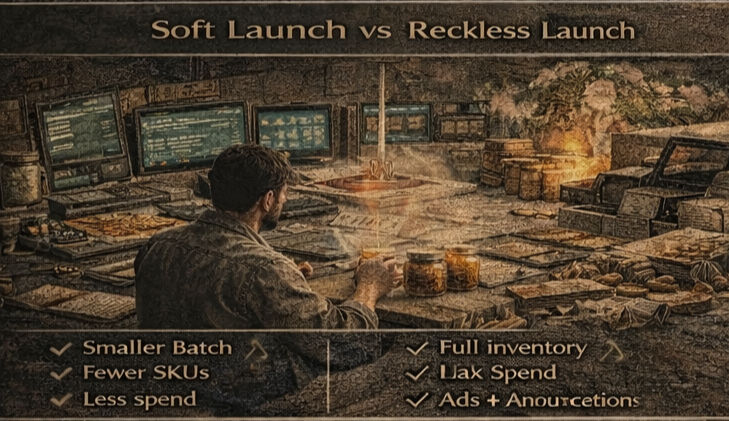
Soft Launch vs Hard Launch
Soft Launch (Recommended)
A soft launch is:
Limited geography
Limited SKUs
Limited channels
Limited marketing spends
Purpose:
Detect issues
Validate assumptions
Improve before scale
Hard Launch (Dangerous Early)
A hard launch involves:
Wide distribution
High marketing spends
Full catalogue exposure
This amplifies mistakes at maximum volume.
Choosing the Right First Channel
Why You Should Not Launch Everywhere
Founders often try:
Website
Amazon
Flipkart
Instagram
WhatsApp
Simultaneously.
These fractures focus on and hide problems.
Choose one primary channel to observe reality clearly.
Channel Characteristics
Marketplaces: High trust, high scrutiny
D2C Website: Full control, low initial trust
Offline: Slow feedback, physical risk
Each channel teaches different lessons.

SKU Discipline at Launch
Why Fewer SKUs Win
Every SKU adds:
Inventory risk
Complexity
Cash lock-in
At launch:
2–4 SKUs is ideal
Focus on consistency, not variety
Depth beats breadth early.
Pricing at Launch: Stability Over Attraction
Early pricing should:
Reflect real costs
Avoid deep discounts
Build expectation consistency
Changing prices too often confuses customers and damages trust.

Packaging & Label Stress Testing
Launch exposes:
Transit damage
Storage issues
Label legibility
Customer handling experience
Small failures become obvious immediately.
Managing Early Reviews and Feedback
Reviews Are Data, Not Emotion
Early reviews reveal:
Flavour expectations
Packaging flaws
Usage misunderstandings
Responding emotionally or defensively is fatal.
Every complaint is a diagnostic tool.
Customer Support Is Part of Launch Strategy
Silence after the sale feels like abandonment.
Early support builds:
Trust
Patience
Forgiveness
Fast responses convert angry buyers into loyal advocates.
Inventory Risk Management
Overproducing for launch:
Locks cash
Creates expiry risk
Forces discounting
Underproducing:
Limits learning
Reduces data quality
Balance is a strategy.
Marketing During Launch: Observation Over Aggression
Marketing at launch should:
Attract the right users
Not maximize reach
Not chase vanity metrics
Your goal is signal clarity, not volume.
Metrics That Matter in Launch Phase
Ignore:
Followers
Likes
Reach
Track:
Repeat purchase
Complaint frequency
Refund reasons
Fulfilment issues
These metrics predict survival.
Why Founders Burn Out During Launch
Launch overwhelms founders because:
Too many channels
Too many assumptions
Too much ego attached
A disciplined launch reduces emotional volatility.
When Is a Launch “Successful”?
A launch is successful if:
You learn faster than you lose money
Problems are fixable
Customers return voluntarily
Revenue is secondary.


Comments