
Private Label Spice Manufacturing: The Complete Guide for Global Food Brands in 2026
The private label spice manufacturing market has quietly transformed into one of the most lucrative corners of the global food industry. From boutique gourmet retailers in London to hypermarket chains across the Middle East and health-food shops in Los Angeles, brands of every scale are launching their own spice lines instead of relying solely on legacy suppliers. This shift is not a passing trend — it is a structural change driven by rising consumer demand for authentic flavour, premium positioning and the pursuit of higher margins that only own-brand products can deliver. For any food entrepreneur, retailer or distributor evaluating this route, understanding how private label spice manufacturing actually works has become a strategic priority for 2026 and beyond.
What Is Private Label Spice Manufacturing?
Private label spice manufacturing is the practice of producing spice blends, single-origin spices and seasoning mixes under a retailer's or brand's own label rather than under the manufacturer's name. In simple terms, an experienced production facility handles sourcing, cleaning, grinding, blending, quality testing, packaging and dispatch, while the client controls the recipe, branding and market positioning. The result is a fully finished consumer-ready product that carries your logo, your story and your pricing power.
For fast-moving categories like turmeric powder, garam masala, chilli flakes, biryani mix and premium single-origin peppercorns, this model offers a rare combination of speed to market and control over identity. Instead of investing years in building factories, developing quality-control laboratories and mastering food-safety compliance, growing brands can leverage the expertise of an established manufacturer and focus on what they do best — marketing, distribution and customer experience. Whether you are launching a debut range of five SKUs or scaling a mature portfolio into new export markets, private label production removes the manufacturing complexity from your growth equation.
Key Advantages of Partnering With a Contract Spice Manufacturer
The most obvious advantage is cost efficiency. Building a compliant spice-processing plant capable of grinding, blending, sterilising and packing food-grade product to international standards demands multi-million-dollar capital outlay, dedicated staffing and years of regulatory groundwork. A contract manufacturing partnership converts that fixed expense into a variable one — you pay per unit, scale as demand rises and preserve capital for brand-building activities.
Beyond cost, speed to market is a genuine game-changer. Established manufacturers already possess raw-material contracts, seasoned procurement teams, laboratory infrastructure, packaging suppliers and export-ready documentation. What might take a start-up two years to build internally can be delivered in eight to twelve weeks through a good contract partner. Add to this the depth of product expertise — recipe formulation, moisture control, particle-size optimisation and shelf-life management — and it becomes clear why even publicly listed food brands increasingly outsource select SKUs. Finally, minimum order quantities are increasingly flexible, letting emerging brands test hero SKUs before scaling.

Quality Standards Every Own-Brand Spice Range Must Demand
Quality is the single most important variable in the spice business, because unlike processed foods, spices carry authenticity directly to the palate. A well-run own-brand spice operation adheres to a set of layered standards. Look for FSSAI compliance in India, HACCP-based food-safety systems, ISO 22000 certification, Halal and Kosher certifications where relevant and increasingly organic and non-GMO certifications for premium ranges.
Ask any prospective partner about their moisture-testing protocols, aflatoxin control measures, pesticide residue screening and metal-detection systems on the packaging line. Reputable manufacturers can share third-party laboratory reports, batch traceability records and detailed certificates of analysis for every consignment. Steam sterilisation — as opposed to ethylene-oxide treatment banned in the EU — has become a baseline expectation for buyers exporting into strict jurisdictions. If a manufacturer cannot articulate these systems clearly, they should not be shortlisted.
Packaging and Branding Possibilities for Custom Spice Blends
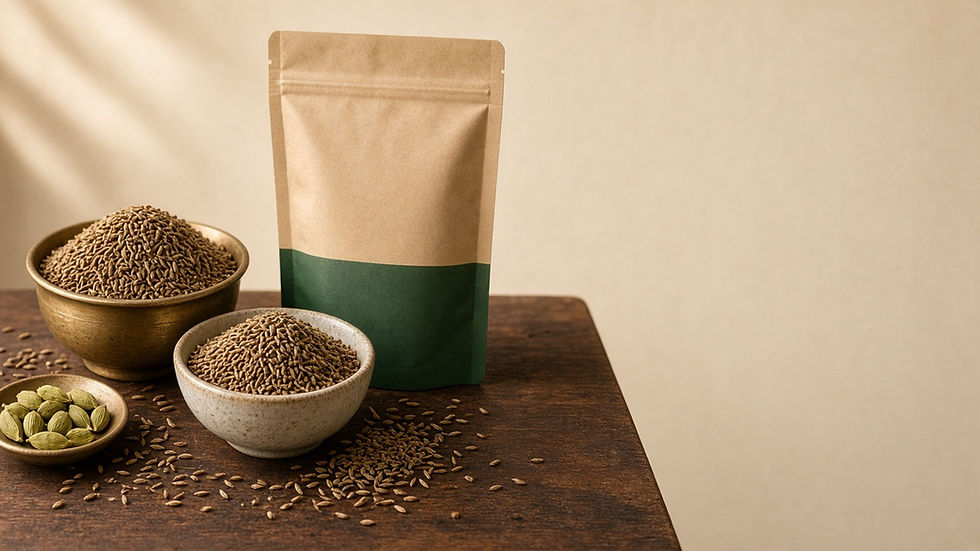
Packaging is where an own-brand range becomes an actual brand. Modern spice manufacturers offer an incredibly broad canvas — polymer pouches with matte finishes, kraft-paper stand-up bags, PET jars, tin canisters, glass shakers, sachets for foodservice and bulk twenty-five kilogram export sacks for wholesale segments. Nitrogen flushing, oxygen absorbers and multilayer barrier films are used to preserve aroma and colour, particularly for high-value products like saffron and premium garam masala blends.
Design flexibility is equally broad. Whether you want minimalist Scandinavian design language, vibrant traditional Indian motifs or clean pharmacy-grade labelling for functional turmeric blends, a good partner will manage prepress, printing and regulatory-compliant labelling in one workflow. Increasingly, retailers request smart packaging features — QR-coded batch traceability, tamper-evident seals, embossed logos and even NFC-enabled premium jars. All of this is now standard vocabulary in the custom spice blend conversation.

Popular Product Categories Under Own-Label Spice Production
The category depth available today is remarkable. On the single-spice side, brands frequently develop own-label ranges around turmeric powder, black pepper, cumin, coriander, chilli powder, cardamom, star anise, cloves and cinnamon. On the blends side, garam masala, chana masala, biryani masala, pav bhaji masala, tandoori masala, chaat masala and sambar powder are perennial best-sellers.
Beyond the classic Indian repertoire, contract partners increasingly formulate regional and international blends — Mediterranean herb mixes, Cajun rubs, Mexican fajita spice, Middle Eastern za'atar, Chinese five-spice and BBQ dry-rubs — often engineered specifically for the retailer's target demographic. Wellness-driven blends have also exploded, with golden-milk mixes, immunity kadha powders, adaptogen-infused turmeric latte blends and low-sodium seasonings dominating premium shelves in North America and Europe.
How to Choose the Right Custom Spice Manufacturing Partner
Choosing a partner is far more consequential than choosing a supplier. The right relationship will influence your product quality, launch speed, cost structure and brand reputation for years. Begin with due diligence — factory audits, references and reviewing recent export shipments to markets like yours. Ask about ownership of the supply chain: does the manufacturer contract-farm turmeric or buy from spot markets? Does it own its own cleaning and sorting lines or does it outsource? Vertical integration is usually a positive signal.
Evaluate technical capability: cryogenic grinding for essential-oil retention, in-house laboratories for microbiological testing and food-safety accreditations such as BRCGS or SQF. Assess commercial fit: minimum order quantities, sample lead times, prototyping willingness and openness to co-developing new SKUs. Finally, evaluate cultural fit — you will exchange thousands of emails with this team and communication style matters. A partner who treats your brief like an internal project, not a transaction, will consistently outperform one that only quotes prices.

India — The Undisputed Hub for Bulk Spice Manufacturing
India accounts for roughly a quarter of the world's spice production and remains the anchor of global trade for turmeric, chilli, cumin, coriander, ginger and countless masala blends. Beyond the raw-material advantage, India offers a mature ecosystem of packaging suppliers, certified laboratories, chartered logistics operators and, critically, generations of culinary expertise embedded in local manufacturers.
For international buyers, the sourcing calculus is simple: you can either buy raw commodities and process them domestically at high cost, or partner with an Indian manufacturer that already processes, blends, tests and packs to your specification. Cities like Ahmedabad, Kochi, Jodhpur and Hyderabad have become nerve centres of the bulk spice manufacturing trade, hosting facilities that export to more than a hundred countries. Regulatory infrastructure has also strengthened, with the Spices Board of India actively supporting exporters through quality certification, trade facilitation and market intelligence.
From Concept to Shelf — the End-to-End Journey
A well-run own-brand engagement typically flows through several distinct stages. The brief begins with a discovery call: target market, flavour profile, price point, expected volumes, packaging preferences and shelf-life expectations. Sample development follows, often across two or three iterations, until the client approves organoleptic and physical benchmarks. Regulatory review then confirms labelling compliance for the destination market — nutrition tables, allergen declarations, batch coding and specific claims such as no added colour.
Once artwork is signed off and packaging materials are procured, production commences under a documented batch record. Quality-control checkpoints run in parallel — raw-material inspection, in-process moisture and colour checks, sensory panels and final release testing. Metal detection and X-ray screening are standard on modern lines. Once released, product is palletised, shrink-wrapped and shipped with export documentation including phytosanitary certificates, health certificates and detailed COAs. From first call to first container, a typical timeline runs eight to sixteen weeks depending on complexity.
Common Myths About Own-Label Spice Production Debunked
Myth: Own-label products are inherently lower quality. In reality, own-label ranges frequently outperform national brands on quality benchmarks because retailers demand tighter specifications to protect their reputation.
Myth: You need enormous volumes to justify a project. Modern manufacturers routinely accept trial runs of a few hundred kilograms per SKU.
Myth: Recipes will be shared with competitors. Reputable partners sign NDAs, ring-fence formulations and keep supplier data confidential.
Myth: Own-label always means cheaper. A growing share of launches sit at the premium end — chef-grade single-origin ranges, organic wellness blends and gourmet chef collaborations.
Why Harvestia Is a Preferred Custom Spice Manufacturing Partner
Harvestia has built its custom spice manufacturing capability around a simple belief — a truly great range needs great agriculture, great science and great storytelling in equal measure. Our sourcing team works directly with farming clusters in Gujarat, Kerala, Rajasthan and Karnataka, ensuring that every consignment of turmeric, coriander, chilli or cumin is traceable to the soil it came from. In-house laboratories manage moisture, ash, aflatoxin and pesticide residue analysis before raw material is ever released into production.
Our processing lines combine modern grinding equipment with steam sterilisation, so buyers exporting to the EU, UK, Japan or the United States can meet the strictest food-safety thresholds without compromise. Packaging design, artwork management and regulatory labelling for the destination market are handled by a dedicated team, and Harvestia's export desk manages documentation, logistics coordination and post-shipment support. For growing food brands and mature retailers alike, the promise is the same — a partner who behaves like an extension of your business.
In the spice trade, the difference between an ordinary label and a beloved brand is almost always the manufacturing partner behind it.
Conclusion — The Next Chapter for Your Spice Brand
The consumer landscape for spices is shifting faster than at any point in recent memory. Buyers increasingly want authenticity, traceability, wellness benefits and beautiful design in the same product. Own-brand spice production has become the fastest, most capital-efficient and most creatively flexible way for brands to meet that demand. Whether you are a start-up planning your first six SKUs or a national retailer overhauling an existing range, the right manufacturing partner will make the journey dramatically simpler. Choose a partner with real supply-chain depth, honest quality systems and the imagination to help you build something distinctive — and the shelf life of your brand will be measured not in months but in decades.


Comments